Cherry blossom season in Japan: the complete hanami guide
Everything you need to know about sakura season in Japan: when to go, where to see the blossoms, and how to experience hanami like a local.
There is a moment each year when all of Japan holds its breath. It happens in late March, when the first cherry trees in the south begin to open their petals and a wave of pink advances slowly northward, transforming parks, rivers, castles, and alleyways into scenes that seem pulled from a dream. This is sakura season, and for the Japanese it is far more than a botanical phenomenon: it is an annual reminder that the most intense beauty is also the most fleeting. In barely a week, the blossoms reach their peak splendor — mankai, full bloom — and shortly after they begin to fall, covering the ground in petals like a pink snowfall. That brief, unrepeatable cycle is what turns hanami into something far deeper than a simple outing to the park.
The hanami tradition: a thousand years of contemplating flowers
The custom of gathering beneath flowering trees has surprisingly ancient roots. During the Nara period (710–794), Japanese aristocrats already held outdoor celebrations to admire blossoms, though in those days the star was the plum blossom (ume), imported from China. It was during the Heian period (794–1185) that attention shifted to cherry trees. Emperor Saga hosted the first sakura viewing parties in the Imperial Court in Kyoto, with banquets, sake, and poetry beneath the flowering branches. The eleventh-century novel The Tale of Genji, written by Murasaki Shikibu, already uses the word hanami to refer exclusively to cherry blossom viewing. For centuries the practice remained a privilege of the nobility and samurai. It was during the Edo period (1603–1868) that hanami was democratized and ordinary people began gathering in parks and gardens to celebrate the arrival of spring. Today, hanami is a collective ritual that unites the entire country: families, friends, and coworkers spread their blue tarps beneath the trees, share bento boxes, drink sake, and celebrate together that fleeting instant when the world turns pink.
Where to see the cherry blossoms: the essential spots
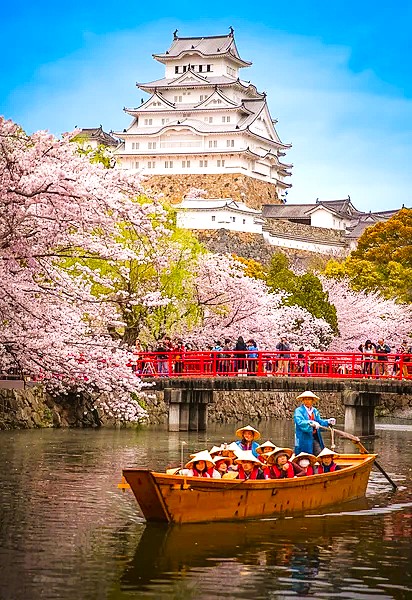
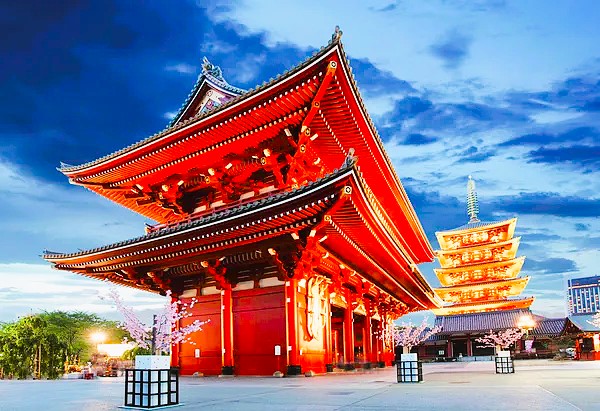
Japan has cherry trees everywhere, but there are places where the bloom reaches an almost supernatural dimension. Himeji Castle is perhaps the most spectacular setting of all: the seventeenth-century white fortress — known as the White Heron Castle for its elegant silhouette — rises above a moat surrounded by more than a thousand cherry trees that in full bloom create a contrast of white and pink that looks as though it were painted. The castle, a UNESCO World Heritage Site since 1993, traces its origins to a fort built in 1333, though the current structure was completed in 1609 by Ikeda Terumasa. It is one of the few original castles to have survived wars and earthquakes.
In Kyoto, the Philosopher’s Path offers a more intimate experience: a two-kilometer trail following a canal lined with hundreds of cherry trees whose branches lean over the water to form a pink tunnel. The path takes its name from the philosopher Nishida Kitaro, who walked it daily in meditation on his way to Kyoto University. In Tokyo, Ueno Park has been the epicenter of hanami for centuries — the first cherry trees were planted by the shōgun Tokugawa Iemitsu — and its roughly 800 trees draw nearly two million visitors during the season. But if one spot in Tokyo captures the magic of sakura, it is the Meguro River: four kilometers of cherry trees on both banks forming a pink tunnel over the water, especially breathtaking when petals begin to fall and blanket the river’s surface like a carpet of silk.
The cherry blossom front: the most anticipated forecast of the year
In Japan the cherry blossom bloom is not merely a natural spectacle; it is an event followed with the same attention as a weather forecast. Every year the Japan Meteorological Corporation and other agencies publish the sakura zensen — literally, the cherry blossom front — a detailed prediction showing when the trees will flower in each region of the country. The front advances from south to north: it starts in Okinawa in January, reaches Kyoto and Tokyo between late March and early April, and arrives in Hokkaido by late April or early May. The dominant variety is Somei Yoshino, which accounts for 70 to 80 percent of Japan’s cherry trees. It was developed by gardeners in the village of Somei near Tokyo during the Edo period, and its simultaneous, explosive flowering — the blossoms appear before the leaves — made it the favorite for planting in parks and avenues. Mankai (full bloom) lasts only about a week, which means the trip must be planned with precision. The good news is that Japanese forecasts are extraordinarily reliable, and in recent years they have even incorporated artificial intelligence to fine-tune the dates.
Yozakura and hanami culture: by day and by night
Hanami does not end when the sun goes down. The tradition of yozakura — viewing cherry blossoms illuminated at night — has its roots in the Edo period, when nobles organized evening gatherings beneath the trees by the light of paper lanterns. Today thousands of parks and gardens install special lighting during the season, and the effect is magical: petals glow against the dark sky, the water of rivers and ponds reflects the luminous pink, and the atmosphere becomes almost dreamlike. Ueno Park and the Meguro River are two of the best places in Tokyo to experience it.
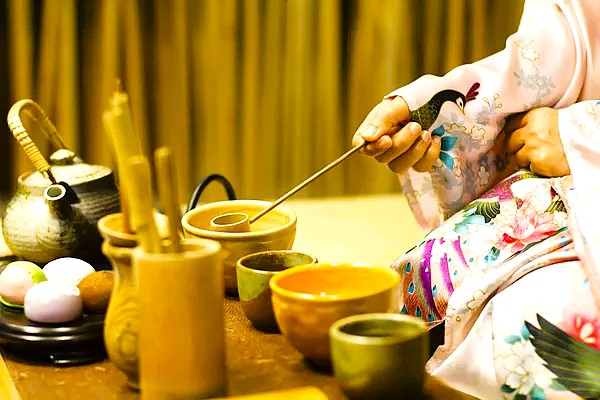
Hanami culture also has its unwritten rules. Groups of friends and office colleagues send the youngest member hours ahead to claim the best spot by spreading a blue tarp beneath the trees — a responsibility taken with absolute seriousness. People bring elaborate bento, sake, beer, and dango (skewered mochi dumplings), and the celebration can last for hours. Basic etiquette includes not damaging the trees, not hanging anything from the branches, taking all rubbish away, and keeping noise to a reasonable level — though this last rule relaxes considerably as the night wears on and the sake takes effect.
Sakura varieties: not all cherry blossoms are the same
The Somei Yoshino is the most common variety —white flowers with a blush of pink lasting barely a week— but Japan has over two hundred types. Yaezakura, with their double petals and intense pink, bloom two weeks after the Somei Yoshino and are perfect for those arriving «late.» Shidarezakura (weeping cherries) create cascades of flowers reaching the ground, with the finest specimens at Kyoto's Daigo-ji temple. In Okinawa the season starts in January with the Kanhizakura, an almost tropical deep pink.
The perfect hanami picnic
Hanami is, above all, a picnic. Japanese spread a blue tarp beneath the trees —the blue tarp is sacred, nobody steps on it— and fill it with konbini bento boxes, sakura mochi (rice cake wrapped in salted cherry leaf), hanami dango (tricolor rice skewers) and cold beer or sake. The unwritten rules: do not take more space than you need, collect all your rubbish and never pluck flowers from the trees. In popular parks like Yoyogi or Maruyama, groups send a member hours ahead to claim a spot with the tarp. It is a friendly competition that is part of the tradition.
Beyond the blossoms: what to do in springtime Japan
Springtime Japan is far more than cherry blossoms, though they remain its undisputed jewel. It is the ideal season to travel the country because the climate is mild, the days are long, and the energy of renewal is felt everywhere. In Kyoto the zen gardens reach peak beauty as the moss greens up after winter. In Tokyo neighborhoods like Shimokitazawa and Yanaka come alive with street markets and impromptu terraces. It is the season for takenoko (bamboo shoots), for Japanese strawberries at their sweetest, and for the first shincha green tea of the harvest. Shrines and temples hold spring festivals with processions, traditional dances, and street food stalls. And if you travel in late April, when the southern blossoms have already fallen, you can chase the bloom northward — all the way to the snowy landscapes of Hokkaido, where the year’s last cherry trees flower against a backdrop of snow-capped mountains.
If sakura season has convinced you it is time to visit Japan, our 10-day Japan guide includes day-by-day itineraries with Google Maps, the best restaurants in each city, transport information including the Japan Rail Pass, weather forecasts, and practical tips for navigating the country like a seasoned traveler.
Comments
Get the best travel tips
Subscribe to the Omyguide blog and never miss an article.
No spam. Unsubscribe anytime.