Kyoto's temples: where Japan keeps its soul
More than two thousand temples and shrines in a single city. A guide to understanding Kyoto without getting lost among so much beauty.
Kyoto has a problem other cities would envy: too much beauty. With more than two thousand temples and shrines scattered among bamboo-covered mountains and neighborhoods where time seems to have stopped in the seventeenth century, it is easy to fall into the trap of trying to see everything. It does not work. Kyoto is not visited with a checklist in hand; it is absorbed slowly, one garden at a time, one torii at a time, until something shifts inside you and you begin to understand why the Japanese consider this city the spiritual heart of their country.
Kinkaku-ji: the gold that never ages
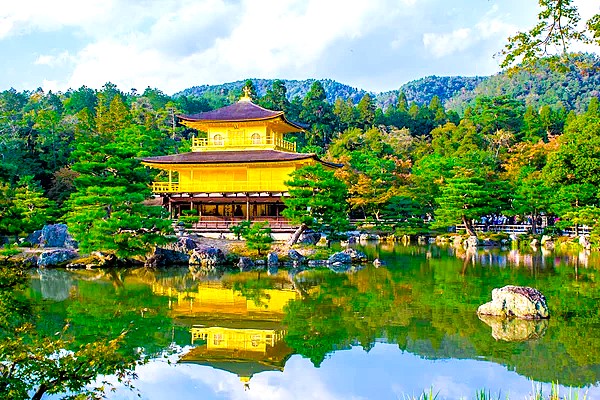
The Golden Pavilion is probably the most reproduced image of Japan after Mount Fuji, and yet seeing it in person remains an almost surreal experience. The top two floors are entirely covered in gold leaf — meticulously restored in 1987 with sheets five times thicker than the originals — and its reflection in the Kyoko-chi pond creates a symmetry so perfect that the brain takes a second to decide which is the building and which is the reflection. The original temple was built in 1397 as a retirement villa for the shōgun Ashikaga Yoshimitsu, who, according to the chronicles, governed the country from here while having officially abdicated. It was destroyed by a disturbed monk in 1950 — an event Yukio Mishima immortalized in his novel The Temple of the Golden Pavilion — and rebuilt five years later.
Fushimi Inari: the path of ten thousand gates
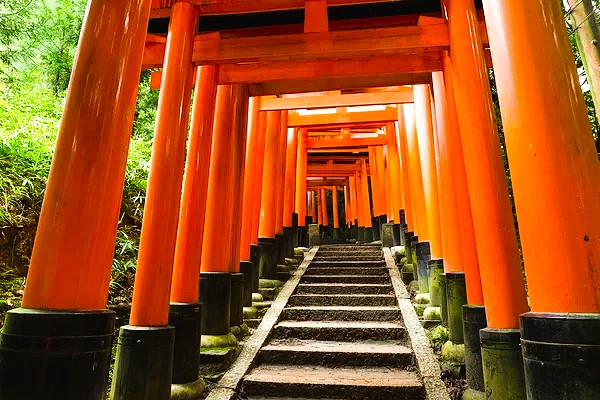
If there is one place in Kyoto that forces you to recalibrate your sense of scale, it is Fushimi Inari Taisha. The shrine dedicated to the god of rice and prosperity extends across the entire Mount Inari, and the path to the summit is lined with more than ten thousand vermilion torii gates donated by businesses and individuals over the centuries. Walking under those tunnels of red gates is a hypnotic experience: light filters through the columns, the forest silence absorbs the noise of the city, and now and then a small shrine appears among the vegetation with fresh offerings of rice and sake. The full climb to the top takes about two hours, but the reward is twofold: the exercise and views of all Kyoto that very few tourists ever see, because most stop within the first three hundred meters.
Kiyomizu-dera: the temple without a single nail
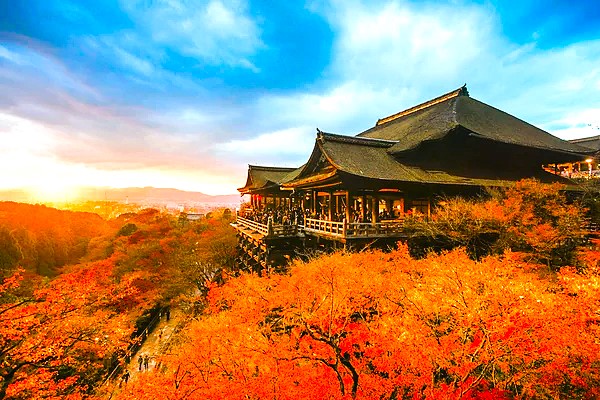
The Temple of Pure Water peers from a wooded hillside like a ship stranded above a sea of trees. Its main terrace, supported by 139 zelkova wood pillars assembled without using a single nail, offers a panoramic view of Kyoto that changes dramatically with the seasons: deep green in summer, fiery red in autumn, pristine white when it snows. There is a Japanese expression, Kiyomizu no butai kara tobioriru — to jump from the stage of Kiyomizu — equivalent to taking the plunge. During the Edo period, 234 people actually jumped; 85 percent survived thanks to the dense vegetation below, which the superstitious interpreted as a sign their wishes would come true.
Zen gardens: the art of nothing
If Kyoto’s great temples impress through scale, the zen gardens do so through absence. The rock garden at Ryōan-ji is the supreme example: fifteen stones arranged on a rectangle of raked white gravel, designed so that from no single vantage point can all fifteen be seen at once. Nobody knows with certainty what it means — zen monks would say that is precisely the point. The garden is contemplated in silence, sitting on the wooden gallery, and the extraordinary thing is that after ten minutes of looking at stones and gravel, something quiets in the mind. It is meditation without instructions, the kind of experience Kyoto offers with a generosity no other city in the world can match.
Gion: where the past walks the street
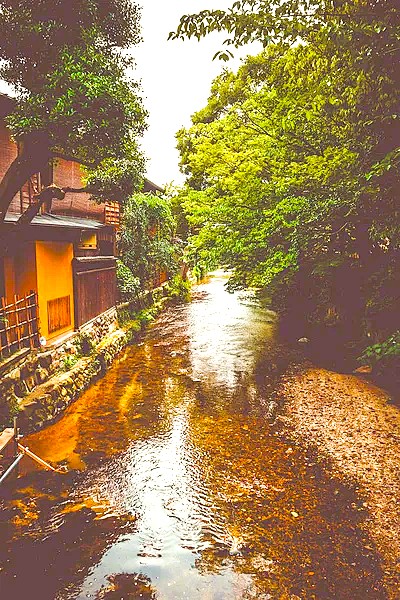
At dusk the cobblestone streets of Gion become a stage from another century. The machiya — traditional wooden houses with slatted facades — line streets lit by paper lanterns, and if you are lucky you may pass a maiko on her way to an evening engagement: flawless kimono, white makeup, wooden sandals clicking against the stones. Gion is not a theme park; it is a living neighborhood where ochaya (tea houses) still operate as they did two hundred years ago, where geisha maintain an art that demands years of training, and where the line between past and present blurs in a way only Japan can achieve.
Arashiyama: bamboo, bridges and monkeys
The Arashiyama bamboo grove is one of those places photographs cannot capture. The stalks rise twenty meters overhead, filtering light into an almost underwater effect. The trick: arrive before seven in the morning. By nine the path is so crowded it loses all magic. From there, Tenryu-ji temple —with its UNESCO Zen garden— is a five-minute walk, and Togetsukyo bridge over the Katsura River offers one of Japan's most iconic views, especially in autumn with crimson maples as backdrop.
For the adventurous, Iwatayama Monkey Park sits uphill: twenty minutes climbing, but the views of Kyoto from the summit —with Japanese macaques roaming freely— make every drop of sweat worthwhile.
Temple etiquette
Before entering any temple, stop at the temizu: the purification fountain where you wash your left hand first, then your right, and rinse your mouth without drinking directly from the ladle. At Shinto shrines, bow twice then clap twice; at Buddhist temples, a single bow with no clapping. Remove your shoes whenever you see footwear at the entrance. Never point at Buddha statues. And if collecting goshuin —calligraphic seals each temple stamps in a special booklet— appeals to you, buy the booklet at the first temple. It is one of Japan's most authentic souvenirs.
When to go: the city of four seasons
Kyoto is a destination for all four seasons, but each offers something radically different. Spring (late March to mid-April) brings hanami, the contemplation of cherry blossoms, and the entire city turns pink for two magical weeks. Autumn (November) is equally spectacular: Japanese maples catch fire in reds, oranges, and yellows that turn every temple into a work of natural art. Summer is hot and humid but has the advantage of festivals like Gion Matsuri in July, a float procession that has been held for over a thousand years. And winter, the best-kept secret: temples dusted with snow, nearly empty, with a stillness that amplifies everything.
If Kyoto’s temples have left you wanting more, our Kyoto weekend guide includes optimized itineraries with Google Maps to see the essentials without overwhelm, restaurants for trying kaiseki cuisine, transport information, opening hours for every temple, and practical tips for navigating the city like a local.
Comments
Get the best travel tips
Subscribe to the Omyguide blog and never miss an article.
No spam. Unsubscribe anytime.