The Amalfi Coast: Europe's most beautiful stretch of shoreline
Complete guide to the Amalfi Coast: Positano, Amalfi, Ravello, the Path of the Gods, local cuisine, transport tips and how to explore it at your own pace.
There is a bend on the SS163 road — roughly at Conca dei Marini — where the Mediterranean appears suddenly between two mountains and the blue is so intense it looks painted. At that moment, with the car barely doing thirty kilometers an hour because the road allows nothing more, you understand why the Amalfi Coast has been fascinating everyone who passes through for centuries. It is not just a landscape: it is a statement of intent from nature, which decided to compress into fifty kilometers of coastline everything it is capable of. UNESCO understood this in 1997, when it inscribed these cliffs, villages and lemon terraces as a World Heritage Site, recognizing what travelers, artists and writers had known for generations: that this corner of the Campania region is an exceptional example of Mediterranean landscape where humanity has coexisted with dramatic topography for over a thousand years.
The SS163: a road of vertigo and beauty
The strada statale 163 Amalfitana is both the area's greatest attraction and its greatest challenge. Its story begins in 1807, when Joseph Bonaparte, fascinated by the coast during a visit, ordered the construction of a road to connect these cliff-bound villages. The works lasted nearly forty years and the road was finally inaugurated on January 12, 1853, linking Vietri sul Mare with Amalfi. Since then, the SS163 has wound along just over fifty kilometers between vertical rock walls, with hairpin bends that barely leave room for two vehicles and that offer, at every turn, views capable of leaving even the most seasoned driver breathless.
Driving it is an experience that combines vertigo, beauty and the adrenaline of meeting a bus on a blind bend. It is considered one of the most spectacular scenic roads in the world, a fact confirmed by travel magazines and European road trip lists that invariably include it. The trick the locals know: go early. Before nine in the morning the road is a different world — empty, silent, with dawn light gilding the cliffs. After midday it becomes a monumental traffic jam, especially between June and September.
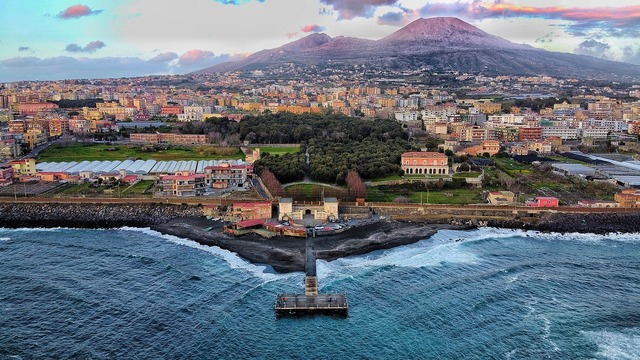
Positano: the vertical village
Positano is the village that appears in every photograph and that, for once, does not disappoint in person. Its pastel-colored houses — pinks, terracottas, yellows, whites — cascade down a cliff to a dark pebble beach, creating a visual composition that seems designed by a set decorator with an infallible sense of harmony. But Positano has a catch: everything is stairs. Going up and down is the main activity, and what looks like a five-minute walk from above can become twenty minutes of steps under the Campanian sun.
In return, each level reveals a different perspective. At the bottom, boutiques of beachwear fashion and custom-made sandal shops — positanesi fashion is an artisanal tradition dating back to the 1950s, when Positano became a refuge for artists and bohemians. In the middle zone, bougainvillea-draped alleyways where silence is broken only by conversations drifting down from the terraces. And presiding over everything, the church of Santa Maria Assunta, recognizable by its polychrome majolica dome in shades of green and yellow, visible from any point in the village and from the sea. The best time to enjoy Positano: at sunset, when the facades turn pink and orange, the beach restaurants light their candles and the silhouette of the Li Galli islets stands out against a sky that looks ablaze.
Amalfi: the forgotten republic
It is easy to forget that Amalfi was one of Italy's four great maritime republics, alongside Pisa, Genoa and Venice. In the eleventh century, when these four powers dominated Mediterranean trade, Amalfi's navigators reached as far as Byzantium and North Africa. Its maritime code — the Amalfi Tables — regulated naval commerce for centuries and laid the foundations of modern maritime law. Today, what remains of that glory is the cathedral and the memory, but both are impressive.
The Duomo di Amalfi, dedicated to Sant'Andrea (Saint Andrew), is an architectural extravaganza that blends styles the way a merchant blends spices in an Eastern bazaar. Founded in the ninth century and expanded in the thirteenth by Cardinal Pietro Capuano, the temple has accumulated layers: Arab-Norman, Gothic, Renaissance and Baroque elements coexist in a polychrome facade with a monumental staircase of 57 steps presiding over the main square. Its bronze doors were forged in Constantinople in 1060 and donated by the merchant Pantaleone de Comite. Beneath the high altar lie the relics of the Apostle Saint Andrew, brought from Constantinople in 1208 after the Fourth Crusade. And attached to the temple, the Cloister of Paradise, built between 1266 and 1268, displays interlaced arches of clear Moorish influence that look as if borrowed from the Alhambra.
But perhaps the most surprising thing about Amalfi is not in the village but above it: the Valle dei Mulini, a ravine where the paper mills that made Amalfi one of Europe's first paper producers during the Middle Ages once operated. The ruins, covered in tropical vegetation that has reclaimed the structures, look like the set of an adventure film, and the Museo della Carta documents this almost-forgotten history.
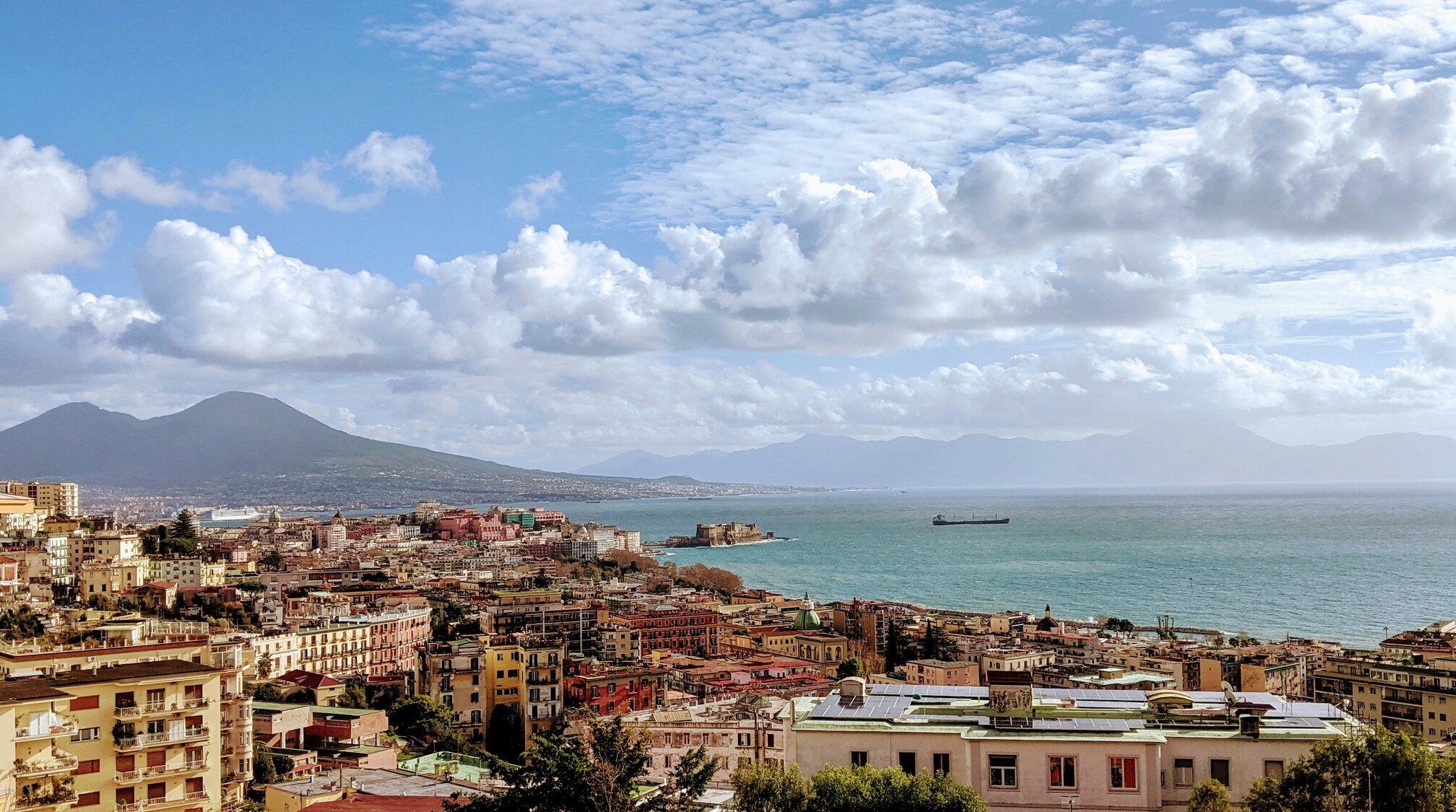
Ravello: the balcony of heaven
Ravello sits 350 meters above the sea and a world away from the coastal bustle. While Positano and Amalfi seethe with tourists, Ravello maintains an aristocratic silence that has attracted musicians, writers and anyone needing to think in peace for centuries. There is no beach here, no harbor: just suspended gardens, medieval palaces and views that have inspired some of the most celebrated works in European culture.
Villa Rufolo, with its gardens hanging over the void, is the place where Richard Wagner found the inspiration he had been seeking for more than two decades. The German composer visited Ravello on May 26, 1880, and upon contemplating the gardens, wrote in the guestbook of the Albergo Palumbo a phrase that has become legend: 'Il giardino magico di Klingsor è trovato' — 'Klingsor's magic garden has been found.' He was referring to the second act of Parsifal, his final opera, whose composition had been stalled. The Villa Rufolo gardens unblocked his imagination, and Parsifal premiered less than two years later, in 1882. Today, a stone plaque at the villa commemorates that moment, and the Ravello Festival, held every summer since 1953 in these very gardens with the Mediterranean as backdrop, was born precisely to honor the connection between Wagner and this place.
Villa Cimbrone, a few minutes' walk away, offers another equally memorable experience. Its Terrazza dell'Infinito is a lookout with marble busts lining a balustrade from which the entire coast stretches to Paestum and, on clear days, the silhouette of Capri floats on the horizon. The American writer Gore Vidal, who lived in nearby La Rondinaia from 1972 to 2004, described it as the most beautiful view he had seen in all his travels. He was not exaggerating.
Praiano: the quiet alternative
Between Positano and Amalfi, halfway between both, hides a village that most tourists see only from the bus window. Praiano is a former fishing village of barely two thousand inhabitants that has managed to preserve its authenticity while its more famous neighbors have transformed into tourist stages. There are no luxury boutiques or Michelin-starred restaurants here: just fishing nets drying in the sun, neighbors who greet each other by name, and sunsets over the Bay of Positano and the island of Capri that count among the most beautiful on the entire coast.
Praiano works as an ideal base for exploring the area. SITA buses pass frequently in both directions, accommodation is notably cheaper than in Positano or Amalfi, and the atmosphere is that of an Italy not yet packaged for mass tourism. Moreover, one of the access points to the Sentiero degli Dei, the coast's most famous hiking trail, starts from Praiano.
The Path of the Gods: walking between sky and sea
The Sentiero degli Dei — the Path of the Gods — is a roughly seven-kilometer hiking trail connecting Bomerano, a hamlet in the municipality of Agerola, with Nocelle, a village in the heights above Positano. At over six hundred meters above sea level, the path winds through fragrant Mediterranean scrub of wild rosemary, abandoned vineyard terraces and natural viewpoints from which the Faraglioni of Capri stand etched against the infinite blue of the Tyrrhenian Sea.
The hike takes between three and four hours at a relaxed pace and requires no technical experience, although there are stretches without protection along the cliff edge that demand caution and good footwear. The best time to do it is in spring — April and May — or in autumn — September and October — when temperatures are pleasant and the light is perfect for photography. In summer, the midday sun beats down mercilessly and the trail fills with hikers. To reach the starting point, take the SITA 5080 bus from Amalfi to Bomerano; the journey takes about forty minutes.
Limoncello, anchovies and the flavors of the coast
The gastronomy of the Amalfi Coast revolves around two products that grow on its cliffs and in its waters: lemons and anchovies. The sfusato amalfitano lemon is an enormous fruit with thick, intensely fragrant skin that grows on stepped terraces shielded by chestnut netting against wind and excessive sun. From this lemon comes artisanal limoncello — not the industrial liqueur sold in airports, but a version where the peel is macerated in alcohol for weeks and the result is served ice-cold after a meal, tasting like concentrated summer in a glass.
But lemon permeates all local cooking. Scialatielli al limone — a fresh, short, thick pasta invented in the 1960s by chef Enrico Cosentino — is made with dough that includes milk instead of eggs, basil and Parmesan, and is typically served with seafood from the coast: clams, prawns, squid. And to finish a meal, the delizia al limone — a sponge cake soaked in limoncello, filled with lemon cream and covered with a citrus glaze — is the region's signature dessert, created by master pastry chef Carmine Marzuillo and transformed in less than forty years into the sweet symbol of the Amalfi Coast.
At the other end of the spectrum lies Cetara, a tiny village that keeps alive a thousand-year-old fishing tradition. Its star product is colatura di alici, a sauce of anchovies fermented in chestnut barrels with Trapani salt for up to three years, a direct descendant of Roman garum. In fact, the name of the village itself may derive from cetariae, the fish-processing facilities the Romans established on this coast. The colatura, an amber liquid of intense flavor and deep umami, was granted Protected Designation of Origin status in 2020 and is one of Italian cuisine's most coveted condiments — a secret almost nobody outside Campania knows.
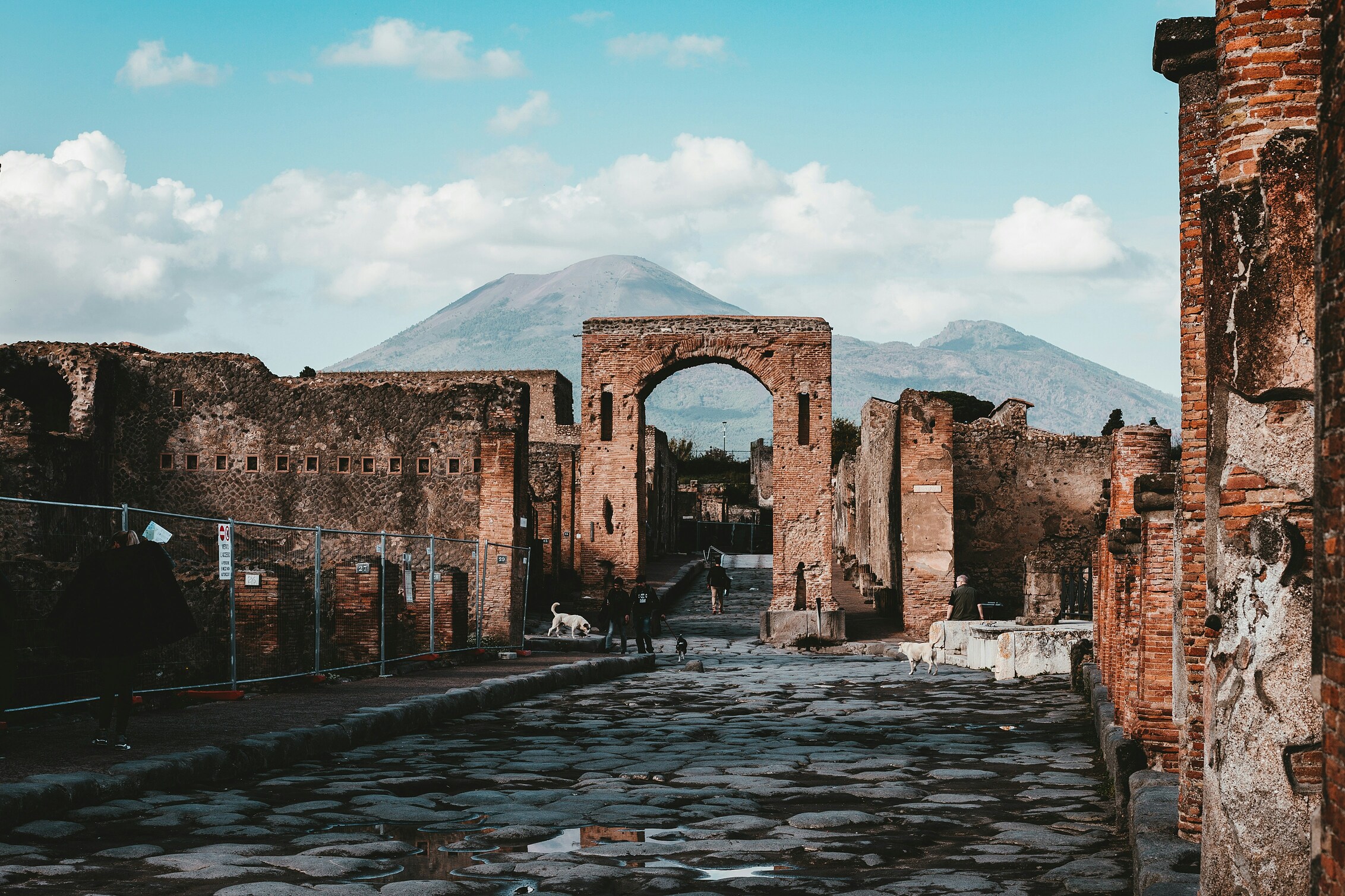
Pompeii and Herculaneum: history beneath the ashes
Few destinations in the world allow you to combine beach, mountains and world-class archaeology within such a small radius. Pompeii and Herculaneum, the two cities buried by the eruption of Vesuvius in 79 AD, are less than an hour from the Amalfi Coast and make a day trip that is hard to pass up. Pompeii is the larger and more famous: a city frozen in time where streets, shops, baths, frescoes and the traces of everyday Roman life are preserved. Herculaneum, smaller but better preserved, reveals wooden structures, mosaics and even carbonized papyrus scrolls that survived the catastrophe.
To get there from the coast, the most practical route is to take the SITA bus to Sorrento and from there catch the Circumvesuviana train, which has stops at both archaeological sites. Admission to Pompeii is 20 euros and Herculaneum 16 euros. For Pompeii, plan at least three hours; for Herculaneum, two. A tip: go on a weekday and early, because queues in high season can be brutal.
When to go and how to get around
The Amalfi Coast has two clearly defined seasons. High season — June to September — brings guaranteed sunshine but also crowds, inflated prices and epic traffic jams on the SS163. The recommendation for those seeking the perfect balance between good weather and tranquility: May-June or September-October. In May the lemon trees are in bloom and the scent of lemon blossom is intoxicating; in June the sea is already warm and the days are long. September maintains summer temperatures with half the tourists, and in October prices drop dramatically while the Mediterranean still invites a swim.
Winter is not a bad option if you seek absolute solitude: many hotels and restaurants close, but those that remain open are the genuine ones, and walking along the coast with nobody else around has a charm hard to beat.
For getting around the coast there are three main options. The first is SITA Sud buses, which travel the SS163 connecting all the villages from Sorrento to Salerno. A 24-hour unlimited pass costs 12 euros and allows hopping on and off at will. The second option is ferries, operating from March to November connecting Salerno, Amalfi, Positano and Sorrento; they are more expensive than the bus but infinitely more pleasant, and offer the most spectacular perspective of the coast from the water. The third is a rental car, useful for the freedom it provides but inadvisable in high season: parking is a nightmare, spaces are scarce and the stress of driving the SS163 in traffic can ruin the enjoyment. Private boat services also run along the coast with stops on request, a luxury option that provides access to coves unreachable by land.
To reach the Amalfi Coast from outside the region, the most common option is the train to Salerno — with direct services from Rome in about two hours — and from there take the bus or ferry to Amalfi or Positano. You can also fly into Naples-Capodichino airport and travel by bus or private transfer to the coast, a journey of between an hour and a half and two hours depending on traffic.
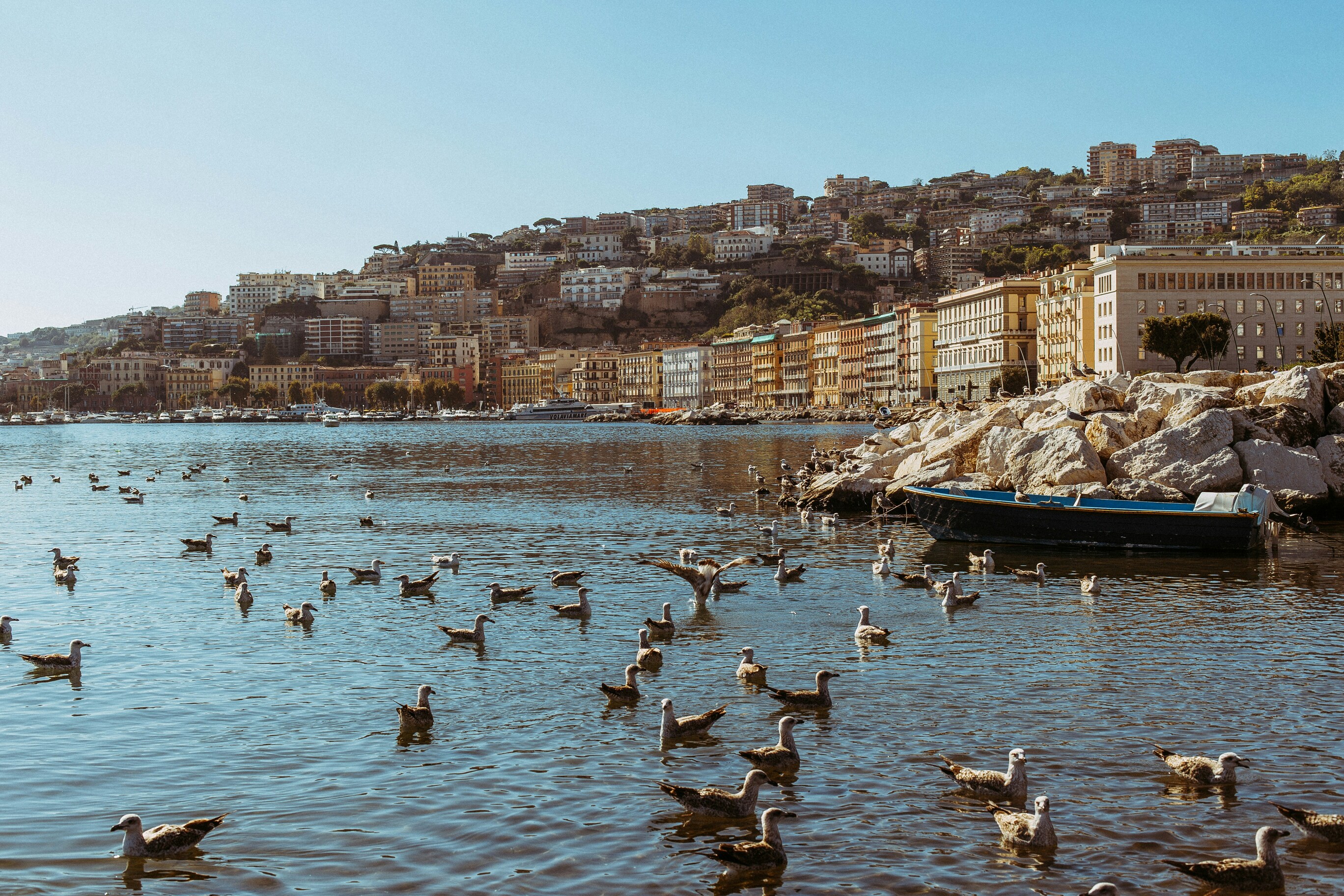
If the Amalfi Coast has won you over, Naples is the perfect gateway. Our Naples weekend guide shows you how to reach the coast from the city, with itineraries featuring Google Maps, recommended restaurants, ferry and bus information, plus everything Naples itself has to offer — from Pompeii to the world's best pizza.
Comments
Get the best travel tips
Subscribe to the Omyguide blog and never miss an article.
No spam. Unsubscribe anytime.