Cinque Terre: five villages perched above the Mediterranean
Five colorful cliff-side villages, thousand-year-old stone terraces, and trails above the Mediterranean. Your complete guide to Cinque Terre.
Some places look like they were designed by a film director with an unlimited budget. Cinque Terre is one of them, except no CGI is needed: impossibly colorful houses stacked on cliffs that plunge vertically into a Mediterranean so deeply blue it looks digital. Vineyards defying all logic, clinging to stone terraces hand-built over more than a thousand years. Trails winding between fishing villages where time seems to have stopped centuries ago. And yet it is all real. So real that UNESCO declared it a World Heritage Site in 1997, and every year millions of travelers discover that photographs, however spectacular, simply do not do it justice.
Cinque Terre is not a single village. It is five: Monterosso al Mare, Vernazza, Corniglia, Manarola, and Riomaggiore, scattered along a mere twelve-kilometer strip of coast on the Ligurian Riviera in northwestern Italy. Five fishing hamlets that for centuries were virtually unreachable by land, connected only by mountain trails and the sea. That very isolation is what preserved them. While the rest of the Italian coastline filled with tourist concrete, these five villages remained intact, frozen in an aesthetic that blends the medieval with the wild.
A millennium of history on the cliffs
The history of Cinque Terre stretches back at least to the eleventh century, when early settlers began carving hillsides to create the agricultural terraces that define the landscape today. Before that, the area was inhabited by Ligurians and later Romans, but it was medieval communities that transformed these impossible cliffs into cultivable land. Stone by stone, without cement or mortar, they raised a system of retaining walls stretching approximately 6,730 kilometers. To put that figure in perspective: it is longer than the Great Wall of China. A feat of agricultural engineering born from the sheer need to survive.
During the Middle Ages the villages belonged to the Republic of Genoa, which fortified them with castles and watchtowers to defend against the Saracen pirates who ravaged the Mediterranean. The towers still visible in Vernazza and Monterosso are direct witnesses to that era. The economy revolved around fishing, olive oil, and above all wine. The terraced vineyards produced Bosco, Albarola, and Vermentino grapes that yielded dry white wines and, in very small quantities, the legendary Sciacchetra.
Isolation was partially broken by the construction of the Genoa-La Spezia railway in the late nineteenth century, which bored through the mountain with tunnels and for the first time connected the five villages practically to the outside world. But the real transformation arrived in the closing decades of the twentieth century, when tourism discovered this coast. In 1997, UNESCO inscribed Portovenere, Cinque Terre, and the islands of Palmaria, Tino, and Tinetto as a World Heritage Site, recognizing the exceptional value of this cultural landscape shaped by human effort in an extraordinarily challenging natural setting. Two years later, in 1999, the Cinque Terre National Park was established, the smallest in Italy yet also the most densely populated, home to around 4,000 residents spread across the five villages.
Monterosso al Mare: beach and tradition
Monterosso is the largest and most western of the five. It is the only one with a proper beach: a strip of golden sand that in summer fills with multicolored umbrellas. The village is divided into two areas separated by a tunnel carved from rock: the old town, with its labyrinth of medieval alleys, the fourteenth-century Church of San Giovanni Battista, and a Genoese defensive tower; and Fegina, the newer section, where hotels and beach life are concentrated. Monterosso is also the gastronomic capital of Cinque Terre: here anchovies are not a mere appetizer but a culinary monument. Monterosso anchovies, salt-preserved following a recipe unchanged for centuries, are famous throughout Italy.
Vernazza: the perfect postcard
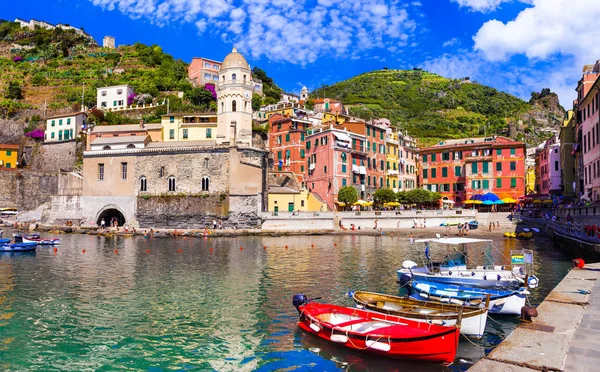
If you had to choose a single image to represent Cinque Terre, it would probably be Vernazza. Its natural harbor, the only one among the five villages, is surrounded by colorful houses climbing the hillside to the Church of Santa Margherita d'Antiochia, built in the fourteenth century with a bell tower rising like a lighthouse above the Mediterranean. Atop the village, the eleventh-century Doria Castle, a Genoese fortress, offers the finest panoramic views along the entire coast. Vernazza has something the other villages lack: a piazza directly over the water, where you can sit for an aperitivo with your feet nearly touching the waves. It is the kind of place that makes you understand why the Italians invented the concept of dolce far niente.
Corniglia: the rebel village
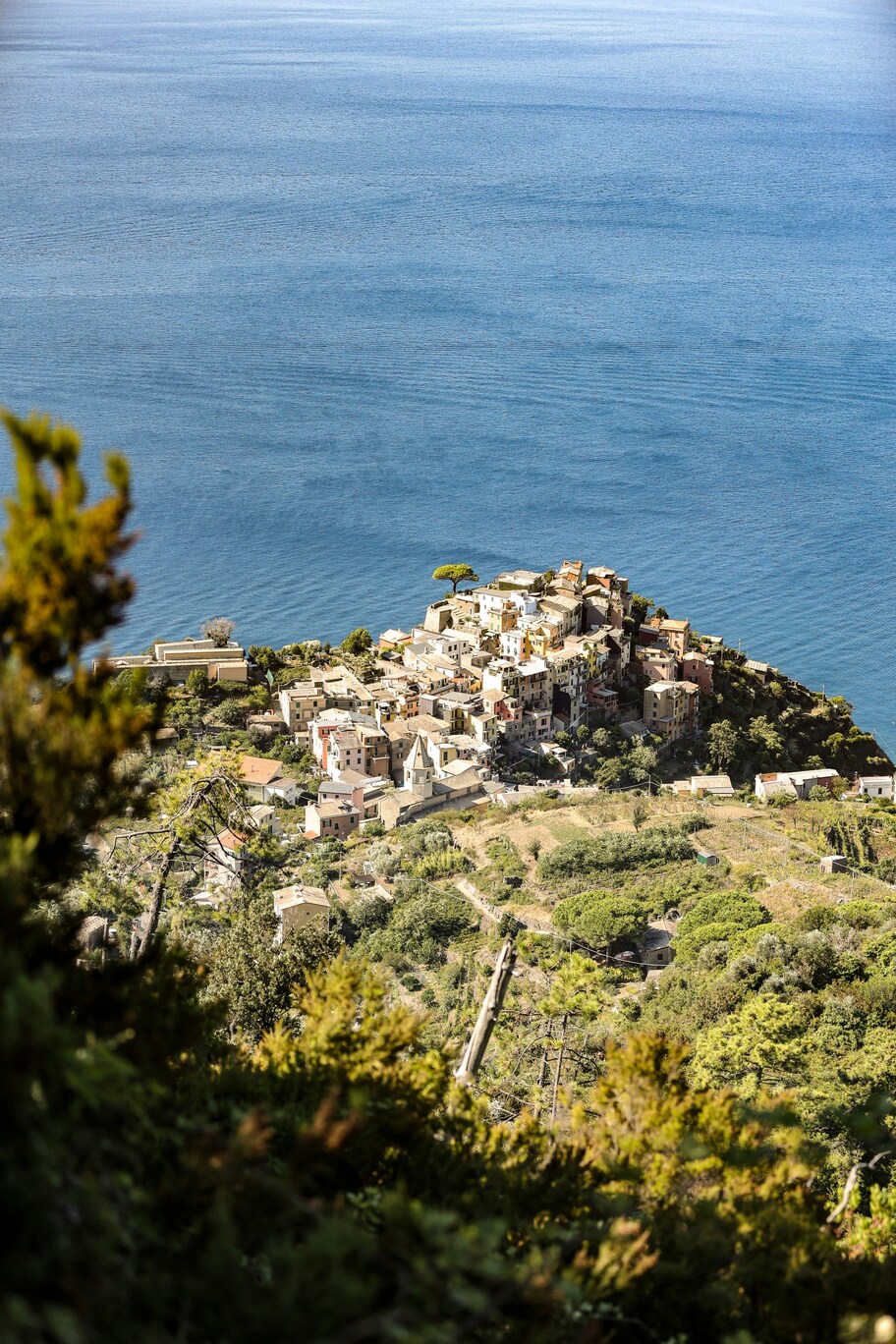
Corniglia is different. It is the only one of the five without direct sea access. It perches ninety meters above the water on a promontory surrounded by terraced vineyards, and to reach it from the train station you must climb the Lardarina, a staircase of 33 flights and 382 steps that is a statement of intent in itself. Whoever ascends to Corniglia has earned it. The village rewards the effort with a tranquility the other four can no longer always offer: fewer tourists, more authentic lanes, and views spanning the entire coast from Punta Mesco to the island of Palmaria. Corniglia has documented Roman origins: its name may derive from Cornelia, the Roman gens that owned the area, and remains of a Roman villa have been found nearby.
Manarola: a village made of photography
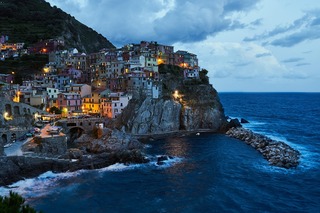
Manarola competes with Vernazza for the title of most photogenic village, and the contest is genuinely close. Its houses seem to grow straight from the rock, stacked in a natural amphitheater that at sunset takes on a warm orange glow, likely the most reproduced image on the entire Italian Riviera. Manarola is also the winemaking heart of Cinque Terre: the vineyards surrounding the village produce the grapes used to make Sciacchetra, and the area's most important agricultural cooperative is based here. The village has a small fishing harbor with boats hauled onto a cement-and-stone ramp, and a main street, Via Discovolo, descending from the Church of San Lorenzo to the water past trattorias where pesto is still made with a mortar, as tradition demands.
Riomaggiore: the eastern gateway
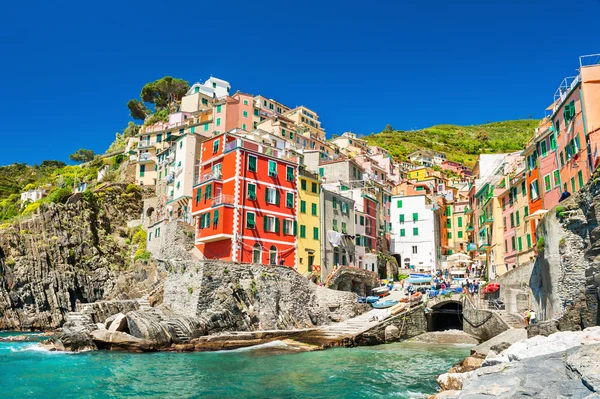
Riomaggiore is the easternmost village and, for many travelers arriving from La Spezia, the first encounter with Cinque Terre. Its tiny harbor, wedged between two rocky cliffs, is full of brightly colored fishing boats contrasting with the dark gray stone. Via Colombo, the main street, descends from the train station to the water past shops, gelaterias, and trattorias competing for your attention with aromas of freshly baked focaccia and fresh basil. Riomaggiore's thirteenth-century castle looms over the village from above and is one of the best vantage points for watching the sunset over the other four villages lined up along the coast.
The Sentiero Azzurro and the Via dell'Amore
Cinque Terre can be covered by train, and indeed all five villages are linked by regionals running roughly every twenty minutes. But doing it only by train is like going to a concert and staying in the lobby. The coastal trails are the soul of this place. The Sentiero Azzurro, the Blue Trail, is the main route: around twelve kilometers connecting Riomaggiore with Monterosso via the other three villages. It has served as the communication path between these hamlets for centuries, long before roads or trains existed.
The most famous stretch is the Via dell'Amore, the Path of Love, linking Riomaggiore to Manarola. This walkway carved into the rock was built in the 1920s and 1930s during the excavation of railway tunnels between the two villages. What began as a path to store explosives away from houses quickly became the most romantic promenade in Italy: the young people of Riomaggiore and Manarola, who previously had to scramble up cliffs with six hundred steps on each side, could at last meet easily. In 2012 a landslide closed the Via dell'Amore, and it did not fully reopen until August 2024 after a restoration lasting more than twelve years. Today it can be walked for a supplement of 10 euros per person, with capacity limited to 200 people every half hour to protect the environment.
Ligurian cuisine between the cliffs
Eating in Cinque Terre is an experience that goes far beyond sustenance. The cooking here is pure Ligurian: simple, built on local ingredients, with flavors reminding you that you stand between mountain and sea. Genoese pesto is everywhere, and here it is made properly: local basil, pine nuts, garlic, Parmigiano, pecorino, and extra-virgin olive oil, ground in a marble mortar. Focaccia, thin and crisp, is eaten at any hour. Monterosso's salt-preserved anchovies are a delicacy with centuries of tradition.
Each village has its specialties. In Vernazza, the herb pie with vegetables and fresh cheese. In Corniglia, honey and lemon pastries. In Riomaggiore, gattafin, fried turnovers stuffed with wild herbs that are thoroughly addictive. And to drink, Sciacchetra: a passito wine made from grapes left to dry for over seventy days in ventilated spaces before pressing. The result is a sweet, golden nectar praised by Petrarch and Boccaccio in the fourteenth century, and which has held DOC status since 1973. It is produced in such tiny quantities that finding it outside Cinque Terre is practically a feat.
When to go and practical tips
Summer, especially July and August, is absolute peak season. Trains are packed, trails are overcrowded, and the alleyways of Vernazza become a slow procession of tourists. If you can choose, the best time is September and October: temperatures remain pleasant for hiking, the light takes on that golden Mediterranean autumn quality, the sea is still warm enough for swimming, and the grape harvest transforms the vineyards into a spectacle of color. Spring, from April to June, is also excellent, with trails full of wildflowers and without the summer crowds.
The Cinque Terre Card is virtually essential if you plan to combine hiking and trains. The version that includes unlimited rail travel between La Spezia and Levanto plus access to National Park trails costs between 19.50 and 32.50 euros per day depending on the season. From 2026, entry to the Via dell'Amore is included in the card, with no separate supplement needed. It can be purchased at any train station in the area or on the National Park website.
A tip few tourists follow: get up early. The villages first thing in the morning, before the trains arrive loaded with day-trippers, have an entirely different magic. Fishermen return with the day's catch, bakers pull the first focaccias from the oven, and the streets are empty except for the occasional lazy cat sunning itself. That is the authentic Cinque Terre, the one that existed before Instagram.
A fact few people know: from Riomaggiore you can take a boat to Porto Venere, a town named after an ancient temple to Venus. There, Lord Byron used to plunge into the sea to swim to his friend Shelley's house, a seven-kilometer open-water crossing that sounds insane today but in the nineteenth century was simply poetry.
If Cinque Terre has won you over, our Cinque Terre weekend guide includes village-by-village itineraries with Google Maps, the best restaurants in each town, train and boat schedules, and every practical detail so you do not miss a thing. Also available in Español, Français, Deutsch, 中文, and Русский.
Comments
Get the best travel tips
Subscribe to the Omyguide blog and never miss an article.
No spam. Unsubscribe anytime.