Cappadocia balloons: flying over an otherworldly landscape
Balloons at sunrise, fairy chimneys, underground cities, and Byzantine frescoes. A complete guide to experiencing Cappadocia from the air and the ground.
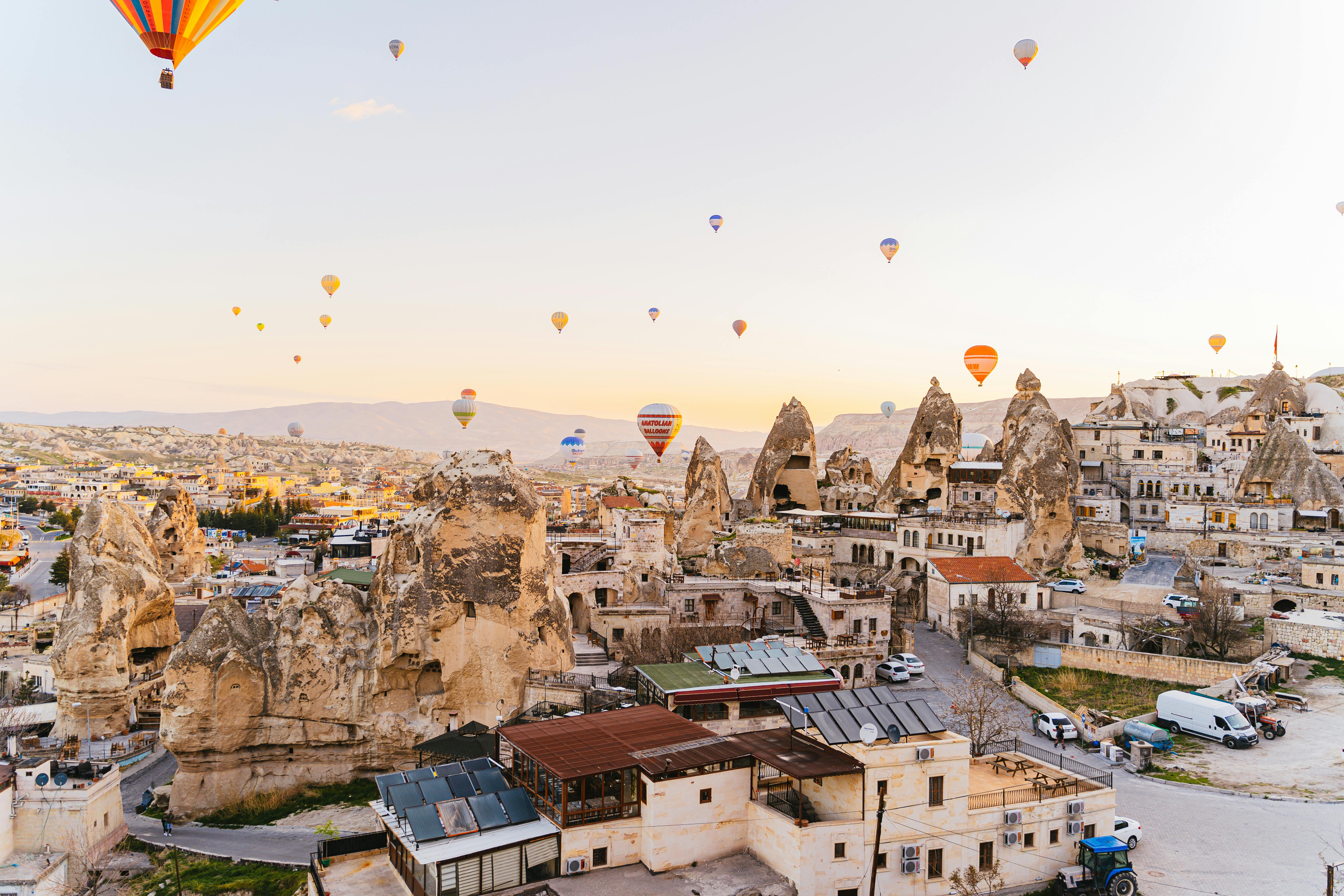
Some places seem invented by a novelist with too much imagination. Cappadocia is one of them. A landscape where rock columns rise like stone sentinels, where entire civilizations carved cities underground to hide from their enemies, and where every sunrise, weather permitting, dozens of hot air balloons ascend in silence over a scene that resembles nowhere else on Earth. The Persians called this region Katpatuka — land of beautiful horses — but what truly defines Cappadocia is not the horses but the rock: millions of years of geological history sculpted by wind, water, and three volcanoes that changed everything.
The fairy chimneys: a landscape forged by volcanoes
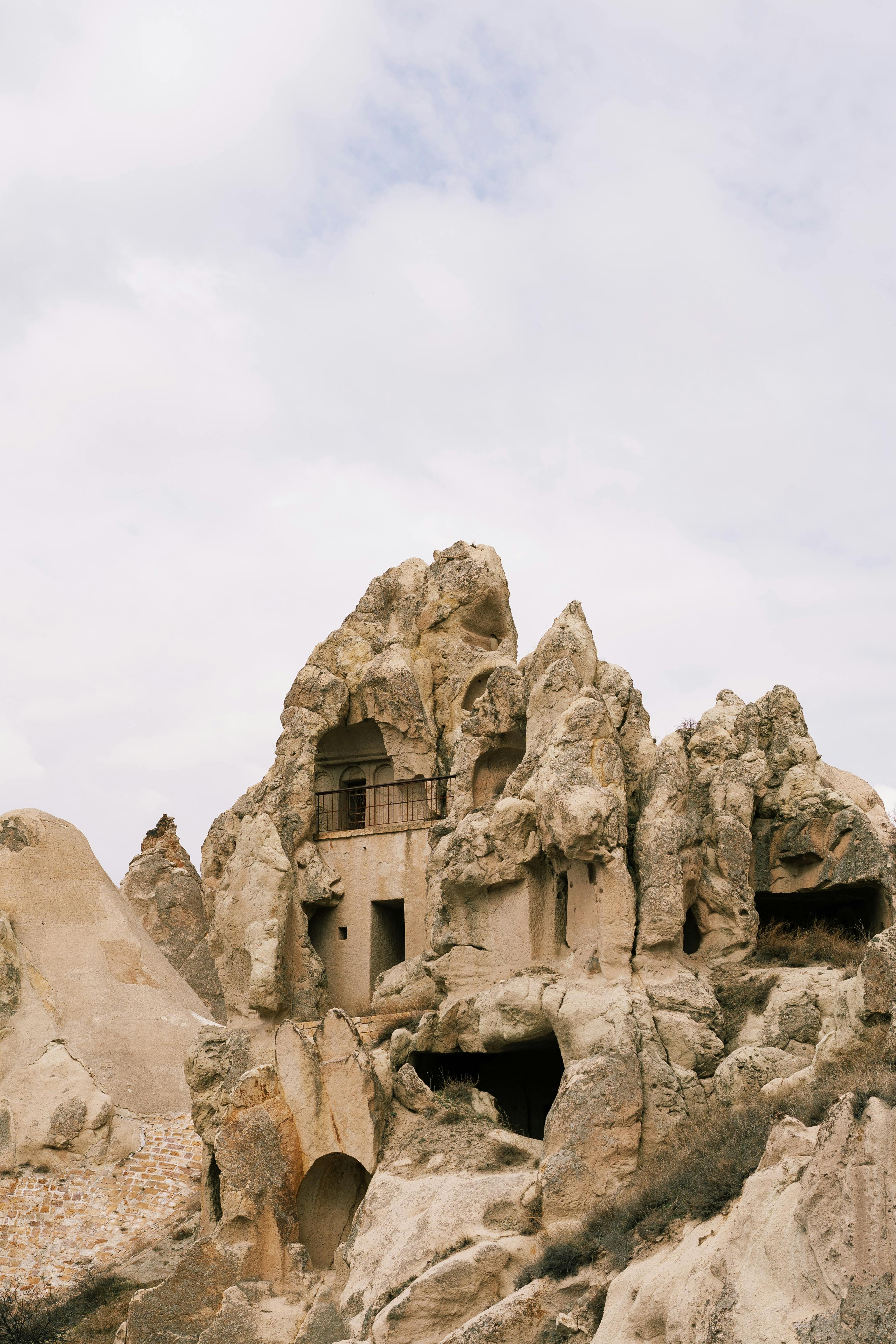
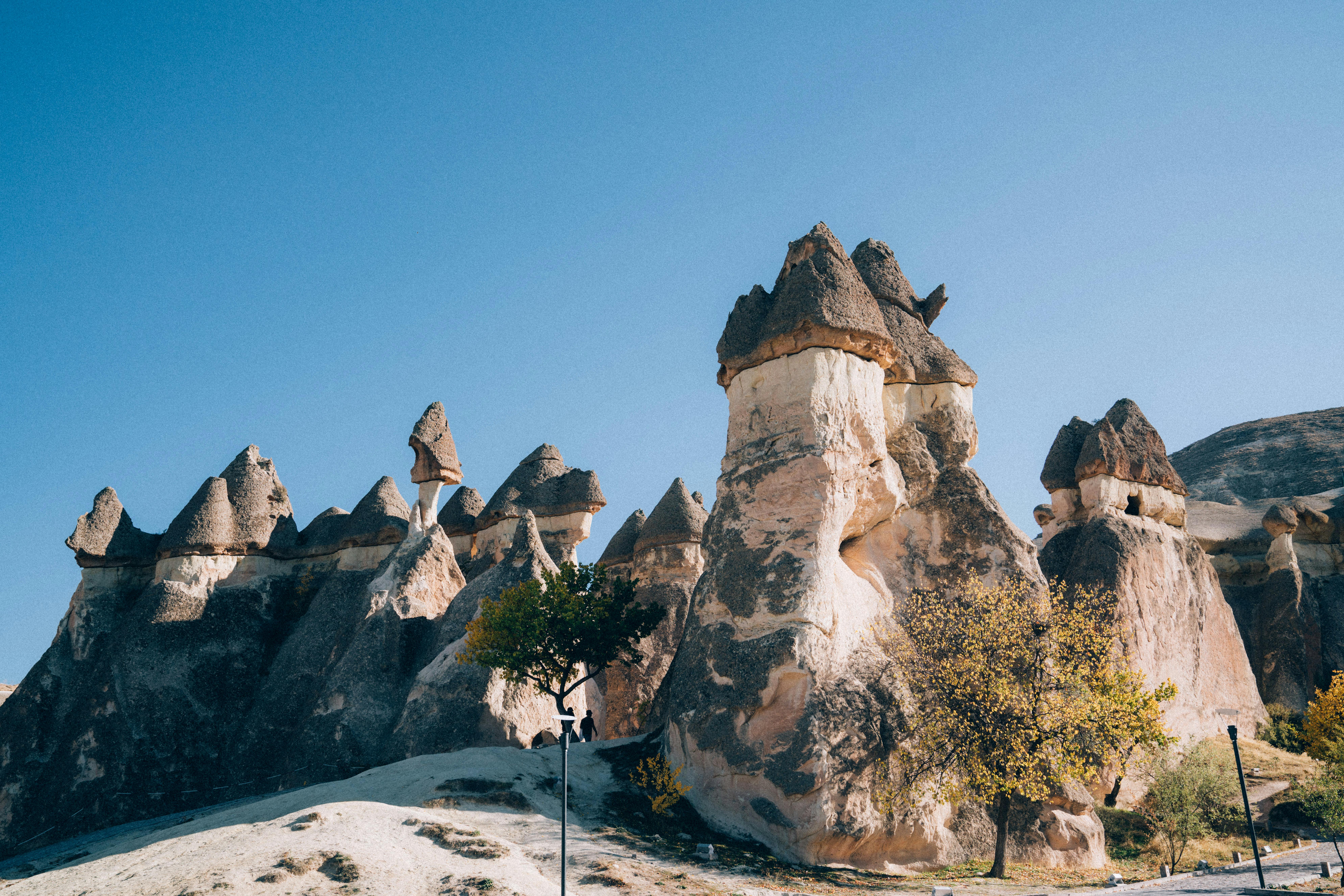
To understand Cappadocia you must go back roughly ten million years, when the Erciyes (3,917 meters), Hasandağ (3,268 meters), and Güllüdağ volcanoes blanketed the central Anatolian plateau with layers of ash, pumice, and lava hundreds of meters thick in places. The dominant material is volcanic tuff — a soft, porous rock formed from compacted ash — interbedded with harder layers of basalt, andesite, and ignimbrite. Over time, erosion did its work: water, wind, and freeze-thaw cycles carved away the softer layers while leaving the harder ones standing as protective caps atop columns of tuff. Thus were born the impossible formations we call fairy chimneys. Some look like giant mushrooms, others like medieval towers, and a few resemble human figures standing watch over the valleys. Göreme National Park holds the most spectacular formations, but the entire region is an open-air geological museum stretching for kilometers in every direction. What is remarkable is not just the landscape itself but that human beings decided not to build on top of it but inside it: they carved homes, churches, monasteries, and entire cities into the soft rock.
Balloons over Cappadocia: history of an icon
The first non-commercial balloon flight over Cappadocia was carried out by the company Raks for promotional purposes in 1984. But commercial passenger flights began in 1991, operated by Robinson Club, with pilots like Kal and Lars taking hotel guests to discover the region from above. In those early days, only a handful of balloons rose each morning. Between 2000 and 2010 the industry exploded: more than fifteen operators were founded and the daily balloon count leapt from five to one hundred in under a decade. Today Turkey's Civil Aviation Authority strictly regulates the maximum — 150 balloons per flight session — along with weather conditions. Balloons over Cappadocia have become one of the most recognizable images in world tourism.
The flight experience: from pre-dawn to champagne toast
The ritual begins well before sunrise. Around four or five in the morning, depending on the season, passengers gather in the dark while pilots inflate the enormous envelopes with propane burners that roar like drowsy dragons. When the balloon lifts off — gently, almost imperceptibly — the sun is about to crest the mountains. Then something happens that no photograph can fully capture: the golden light of sunrise illuminating dozens of colorful balloons floating among the fairy chimneys, with Cappadocia's valleys unfolding below like a relief map. The flight lasts roughly one hour, during which the pilot maneuvers the balloon to different altitudes — sometimes skimming the chimneys, sometimes climbing hundreds of meters for a full panorama. Upon landing, tradition calls for a champagne or sparkling wine toast, accompanied by a small cake and the presentation of a flight certificate. It is a ritual that turns the end of the journey into a celebration.
The Göreme Open-Air Museum: World Heritage
Declared a UNESCO World Heritage Site in 1985 — one of the first sites in Turkey to receive this distinction, and notable for being listed for both its cultural and natural value — the Göreme Open-Air Museum houses an extraordinary collection of rock-cut churches, chapels, and monasteries carved into volcanic tuff. The churches are decorated with Byzantine frescoes dating from the tenth to the thirteenth century, and their state of preservation is often breathtaking. The most famous is the Dark Church — Karanlık Kilise — which owes its name to the scant light that enters through a small window. Paradoxically, that darkness is what preserved its frescoes in an exceptional state: the colors — lapis lazuli blue, ochre red, gold — retain an intensity that seems impossible for paintings a thousand years old. Scenes of the Nativity, the Last Supper, and the Crucifixion cover ceilings and walls with a richness of detail that rivals any Byzantine art museum in the world. And yet here you are not in a conventional museum: you are inside a cave, surrounded by silence, with natural light filtering softly through cracks in the rock. The complex receives more than two million visitors per year, making it one of the most visited sites in Turkey.
The cities beneath the surface: Derinkuyu and Kaymakli
Below the surface of Cappadocia hides another world. More than two hundred underground cities have been discovered, and they rank among the most astonishing engineering feats of antiquity. The earliest tunnels were probably dug by the Phrygians in the eighth to seventh centuries BC, but it was during the Byzantine era that the cities were massively expanded. Anatolian Christians used them as refuges during the Arab-Byzantine wars (eighth to twelfth centuries), the Mongol incursions of the fourteenth century, and later persecutions. Derinkuyu, the deepest, descends eight levels underground and could shelter around 20,000 people along with their animals, grain stores, kitchens, chapels, and a ventilation system that still works today. It was rediscovered in 1963 when a local resident found a mysterious room behind a wall while renovating his home. Kaymakli, connected to Derinkuyu by a tunnel of eight to nine kilometers, is equally impressive. These cities were not temporary shelters but complex settlements designed to withstand sieges for months. The entrances could be sealed with enormous circular stones — weighing up to one and a half tons — rolled into place from the inside. Walking through their narrow passages, ducking under low ceilings, produces a mix of claustrophobia and admiration that is difficult to describe.
Uçhisar: the highest natural fortress in Cappadocia
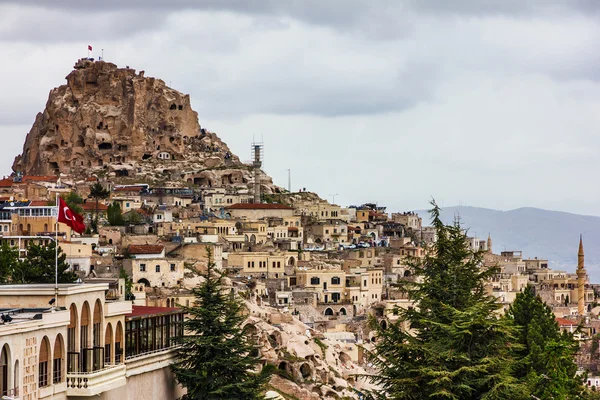
A few kilometers from Göreme rises Uçhisar, whose Turkish name means 'outer citadel.' Its castle is not a conventional structure but a sixty-meter-tall rock spire riddled with hundreds of interconnected rooms and passages. At 1,270 meters above sea level, it is the highest point in Cappadocia — excluding mountain peaks — and from its summit you get the most complete panorama of the region: the Göreme valleys, the fairy chimneys of Love Valley, and on clear days the snow-capped silhouettes of Erciyes and Hasandağ on the horizon. Historically its strategic position made it a watchtower and refuge during invasions: inhabitants stored provisions in its inner chambers and could endure sieges thanks to multiple escape routes carved into the rock.
Paşabağ: the Monks' Valley
Paşabağ is perhaps the place where fairy chimneys reach their most whimsical shapes. Also known as Monks' Valley, it takes its nickname from the hermits who from the fifth century onward settled in these rock formations to lead lives of meditation. Saint Simeon, according to tradition, took refuge in a two-meter-high chimney to escape those seeking his counsel and healing. The chimneys of Paşabağ are mushroom-shaped — slender bodies crowned with dark basalt caps — and some display two or even three heads, giving them the look of fantastical creatures. Strolling among them at sunset, when the raking light intensifies the ochre and pink tones of the tuff, is one of those experiences that justifies the trip all on its own.
The Ihlara Valley: a gorge with Byzantine churches
Roughly eighty kilometers southwest of Göreme, the Melendiz River has carved over millennia a gorge fourteen kilometers long and up to 150 meters deep: the Ihlara Valley. Its walls shelter around one hundred rock-cut churches dating from the Byzantine period, beginning in the seventh century, when monks settled in the canyon drawn by its isolation and the ease of excavating the tuff deposited by eruptions of the Hasan volcano. Sixteen of those churches are open to the public, and many of them preserve frescoes blending Eastern and Western influences in a style all their own. The walk along the valley floor, beside the river and under the shade of poplars, is one of the most beautiful hikes in all of Turkey and a perfect counterpoint to the arid landscapes of Göreme.
Avanos and the pottery tradition
The Kızılırmak — literally 'red river' — flows through the town of Avanos and gives it its reason for being: the red clay carried in its waters has fed a pottery tradition stretching back more than four thousand years, to the Hittite period. Avanos artisans combine this red clay with white clay from the surrounding hills to produce ceramics that for centuries were exported throughout Turkey. Today the pottery workshops are the town's main attraction. Each workshop is run by a family that has passed down the craft for generations, and many offer demonstrations where visitors can sit at the wheel and shape their own piece. It is a tangible connection with a millennia-old tradition that remains alive.
Cappadocian cuisine: the testi kebab
If one dish defines the cuisine of Cappadocia, it is the testi kebab — literally 'jug kebab.' Lamb, beef, or chicken is slow-cooked with vegetables — carrot, onion, garlic, potato, celery — inside a clay pot sealed with bread dough. The slow cooking inside the sealed vessel concentrates all the flavors and juices. When the dish arrives at the table, the waiter cracks the pot open with a small hammer in a theatrical gesture that releases a cloud of aromatic steam. The pots traditionally come from the workshops of Avanos, closing a cultural circle that connects craft, gastronomy, and landscape. Göreme and Avanos are full of restaurants serving this dish, and trying it in a cave converted into a dining room is an experience that appeals to every sense.
When to visit Cappadocia
The best months to visit Cappadocia are April through June and September through November, when temperatures are pleasant — between 15 and 25 degrees Celsius — and weather conditions most stable for balloon flights. Summer can be hot, since the central Anatolian plateau has no sea breeze, and crowds hit their peak. Winter offers extraordinary snow-covered landscapes — balloons over snow-dusted chimneys make a magical image — but the probability of flight cancellation rises considerably. Roughly 30 percent of days see flights cancelled due to wind or rain, so it is wise to plan at least two or three free mornings to allow a margin.
How to book a balloon ride: prices, companies, and safety
Booking in advance is essential, especially in high season, when flights sell out weeks or even months ahead. Prices range from 50 to 350 euros per person depending on the season, basket size — small baskets of eight to twelve passengers offer a more intimate experience than large ones of twenty to twenty-eight — and the company's reputation. Established operators like Royal Balloon, Voyager Balloons, or Butterfly Balloons tend to cost more, but the difference shows: pilots with thousands of flight hours who skim the fairy chimneys, descend into the valleys, and seek out currents to offer the best views. Turkey's Civil Aviation Authority strictly regulates the activity: pilots must hold a current license, balloons undergo periodic inspections, and flights are only authorized when weather conditions are safe. It is an aerial sport with an excellent safety record in Cappadocia, but it is always worth choosing operators with certifications and strong reviews. Practical tip: dress in comfortable layers — mornings are cold but the burners warm things up — and wear closed-toe shoes, as you will need to climb in and out of the basket.
Göreme as a base and final tips
Göreme is the ideal base for exploring Cappadocia: a small town with hotels carved into the rock that are an experience in themselves, good restaurants — many in caves — and easy access to every point of interest. From there you can organize day trips to the Ihlara Valley, the underground cities, and Avanos, as well as hike the nearby valleys or explore by quad. For those with a long weekend, three days are enough to absorb the essentials: a sunrise balloon flight, a morning at the Open-Air Museum, an afternoon among the chimneys of Paşabağ and Uçhisar, and a day to explore the depths of Derinkuyu or Kaymakli. Cappadocia is one of those places where geology, human history, and pure beauty converge in a way that is not repeated anywhere else in the world. It is worth every hour of the journey.
If Cappadocia has left you wanting more, our Cappadocia weekend guide includes itineraries with Google Maps to organize each day, opening hours for key sites, recommended restaurants in Göreme, tips for choosing your balloon flight, and all the practical information you need to make the most of a weekend in this unique region.
Comments
Get the best travel tips
Subscribe to the Omyguide blog and never miss an article.
No spam. Unsubscribe anytime.