Bangkok street food: the world capital of eating on the go
From Yaowarat to floating markets: the dishes, neighborhoods, and secrets that make Bangkok the best place on Earth for street food.
Bangkok is not a city that happens to have good street food. Bangkok is street food. With over 300,000 street vendors — more than 100,000 of them dedicated exclusively to food — this city has turned its sidewalks, alleyways, and canals into the largest open-air restaurant on Earth. People do not eat on the street here out of necessity or haste: they eat on the street because that is where the best cooking happens, where recipes have been perfected over the same blackened wok for decades, where a woman in an apron and ski goggles can earn a Michelin star without even having walls around her kitchen.
Yaowarat: Chinatown after dark
If there is an epicenter of street food in Bangkok, it sits on Yaowarat Road, the main artery of Chinatown. By day it is a noisy, chaotic street, but after sunset it transforms into something else entirely. Red and gold neon signs in Chinese and Thai flicker to life, mobile kitchens wheel their woks onto the pavement, and the perfumed smoke of grilled seafood, stir-fried noodles, and simmering soups creates an aromatic fog that wraps around everything. Yaowarat is where the Sino-Thai culinary tradition was born, and here you can dine on oyster omelets, pork ribs braised for hours in herbal broth, or a simple plate of roast duck rice that costs less than two dollars and tastes better than most tablecloth restaurants in the world. The key is to arrive after seven in the evening and walk without a plan: the best stalls need no signs — you spot them by the queue.
The essential dishes: from pad thai to mango sticky rice
Pad thai is probably the most famous Thai dish on the planet, yet few people know that its story has more to do with politics than gastronomy. During the government of Field Marshal Phibunsongkhram in the late 1930s and 1940s, Thailand was suffering a rice crisis worsened by flooding and the Second World War. The government discovered that the same amount of rice could produce twice as many noodles, so it created and distributed a standardized recipe for stir-fried rice noodles with egg, tofu, dried shrimp, and peanuts. It even handed out free food carts so people could sell them on the street. A national dish was born by government decree. Today a good pad thai in Bangkok costs between 30 and 60 baht — roughly one to two dollars — and is infinitely superior to any version you have tried outside Thailand.
But pad thai is just the gateway. Som tam, the green papaya salad, has its roots in the Isan region of northeast Thailand and arrived in Bangkok with migrant workers who brought their mortars and their love of chili. It is made by pounding shredded green papaya with cherry tomatoes, long beans, peanuts, lime, fish sauce, and as much chili as you dare. Then there are boat noodles — intensely flavored noodle soups originally served from boats on the canals — now found in tiny bowls for about 15 baht each: the idea is to order several. And to finish, mango sticky rice: glutinous rice cooked in coconut milk, crowned with slices of ripe mango and a drizzle of salted coconut cream. It is the perfect dessert, especially between April and June when mango season turns Bangkok into a sweet paradise.
Floating markets: food on the water
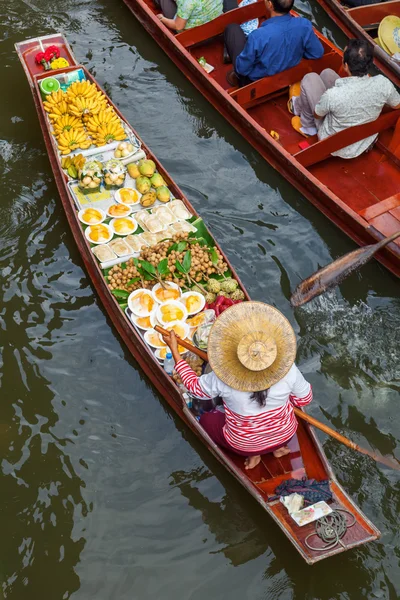
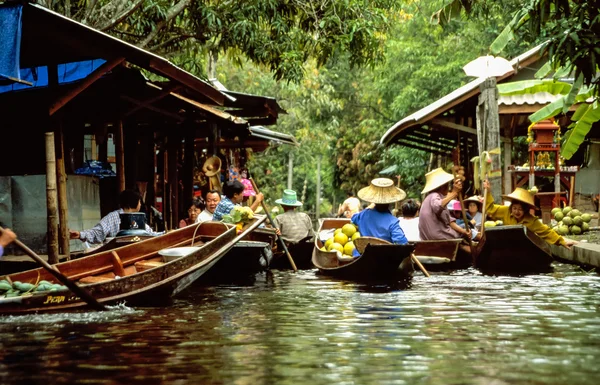
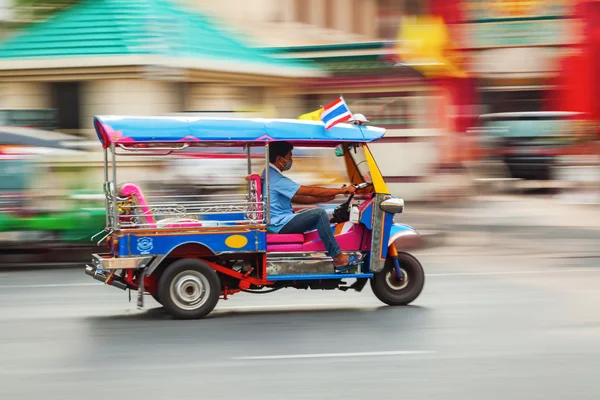
Before roads crisscrossed Bangkok, canals were the city’s highways. And floating markets were its shopping centers. Several survive today, each with its own personality. Damnoen Saduak, about a hundred kilometers southwest of the capital, is the most famous and photogenic: dozens of wooden boats laden with tropical fruits, soups, and curries navigate narrow canals while vendors in conical straw hats pass food directly to your boat. It is thoroughly touristy, but the visual spectacle is worth the trip. For something more authentic, there is Amphawa, which opens only Friday through Sunday in the late afternoon and evening. Amphawa draws mainly Thai families, and the experience feels less staged: food stalls line the canal banks, you dine with your feet dangling over the water, and after dark there are boat excursions to see fireflies glowing among the trees.
Jay Fai and the Michelin star revolution
In 2018, when the Michelin Guide arrived in Bangkok for the first time, something happened that shook the culinary world: Supinya Junsuta, known as Jay Fai, a street food vendor in her seventies who cooked wearing ski goggles to shield herself from spattering oil, received a star. Her restaurant has no walls, no air conditioning, no elegant menu. It has a wok, a flame, and decades of refined technique. Her crab omelet, golden and crispy on the outside, juicy and packed with crab meat inside, has become one of the most coveted dishes in Asia. Jay Fai proved that culinary excellence does not require linen tablecloths: sometimes it just needs a plastic stool and a cook who has been doing the same thing every single day for half a century. Her star was a symbolic revolution that placed Bangkok — and its entire street food culture — on the global gastronomic map.
How to eat street food like a local
The first rule is turnover: eat where you see crowds. A stall with a constant queue means fresh, just-cooked food. An empty stall with food already sitting out is a gastronomic gamble. The second rule is timing: street breakfast starts at six in the morning with congee (rice porridge), gai tod (fried chicken), and tooth-achingly sweet iced coffee; lunch peaks between eleven and one; and street dinner — the best meal of the day — kicks off at six in the evening. In between, snack vendors offer grilled pork skewers, spring rolls, and fresh fruit cut with salt, sugar, and chili.
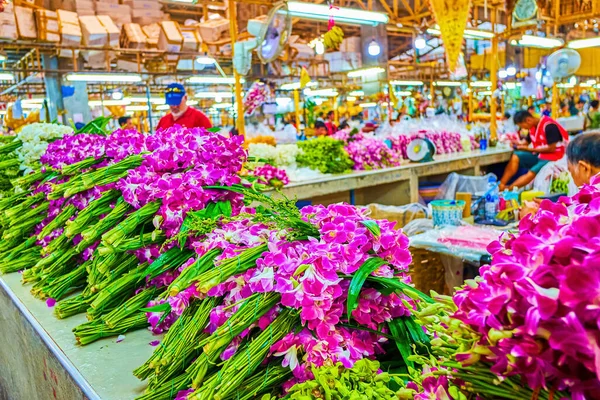
Prices are absurdly low: between 30 and 60 baht per dish, or roughly one to two dollars. You can eat until you are full for under five dollars. For standout market experiences, Or Tor Kor — ranked by CNN as one of the best fresh markets in the world — offers tropical fruit of extraordinary quality, while Khao San Road, touristy as it may be, packs an unrivaled variety of food from every region of Thailand into a few hundred meters.
A practical tip: always carry tissues and do not be afraid to point at what you want. The language barrier disappears when both sides agree that food is the best universal language.
If Bangkok has whetted your appetite, our 5-day Bangkok guide includes day-by-day itineraries with Google Maps, recommended restaurants and stalls by neighborhood, dishes to order in each area, and all the practical information you need to navigate the Thai capital like a local.
Comments
Get the best travel tips
Subscribe to the Omyguide blog and never miss an article.
No spam. Unsubscribe anytime.