Chiang Mai Temples: the spiritual soul of northern Thailand
Explore Chiang Mai's Buddhist temples: Doi Suthep, Wat Chedi Luang, Wat Phra Singh and more. Lanna Kingdom history, etiquette and tips.
Some cities are visited for their beaches, others for their food, and then there is Chiang Mai, a city people visit for its temples. More than 300 wats dot the landscape of this former capital of the Lanna Kingdom in northern Thailand, turning every corner into a gilded postcard where saffron-robed monks, awestruck tourists and locals leaving floral offerings before work all coexist. But Chiang Mai is not just a collection of photogenic temples. It is a place where Theravada Buddhism remains the axis of daily life, where young men still ordain as temporary monks as a rite of passage, and where temple bells have been marking the rhythm of the days with the same punctuality since the 13th century. To understand Chiang Mai you must understand its temples, and to understand its temples you must understand the kingdom that built them.
The Lanna Kingdom: a thousand temples for a million rice fields
The name Lanna literally means "a million rice fields," and that was precisely the dream of King Mengrai when he founded Chiang Mai on April 12, 1296. Mengrai did not act alone: according to tradition, he consulted with King Ramkhamhaeng of Sukhothai and the ruler of Phayao to design the new capital, an episode commemorated today at the Three Kings Monument in the heart of the old city. Mengrai chose the site for its fertile valley, watered by the Ping River, sheltered by mountains and blessed with a cooler climate than the central plains of Siam. But his ambition went beyond agriculture: he wanted Theravada Buddhism to be the pillar of the state, and that meant building temples. Many temples.
The Lanna Kingdom flourished for over two centuries as an independent center of culture, art and Buddhist religion. Its artisans developed a distinctive architectural style, recognizable by multi-tiered roofs that slope almost to the ground, nagas (mythical serpents) guarding the staircases, and elaborate carvings in wood and gilded stucco. That style survives intact in Chiang Mai's temples, which function as a living museum of Lanna civilization. The kingdom maintained its independence until the Burmese conquered it in 1558. Chiang Mai spent over two hundred years under Burmese rule before being liberated in 1774 by King Taksin and subsequently incorporated into the Kingdom of Siam. This turbulent history explains why some temples show Burmese influences alongside the original Lanna style.
Wat Phra That Doi Suthep: the sacred mountain
If you could visit only one temple in Chiang Mai, it would have to be this one. Perched at 1,073 meters on the slopes of Doi Suthep -- a 1,676-meter mountain that dominates the city -- Wat Phra That Doi Suthep is the most sacred temple in northern Thailand. Its story begins with a legend every Thai person knows: in 1383, a monk named Sumana brought a relic of the Buddha's shoulder bone from Sukhothai. The relic miraculously split in two. One half was enshrined at Wat Suan Dok, on the outskirts of the city. The other was placed on the back of a white elephant and set free in the forest. The elephant climbed the mountain, trumpeted three times and collapsed. King Kue Na interpreted this as a divine sign and ordered a temple built on that exact spot.
To reach the temple you must climb 306 steps flanked by two magnificent seven-headed nagas, a staircase that has become one of Chiang Mai's visual icons. There is also a funicular for those who prefer to skip the climb. At the top awaits a 24-meter golden chedi covered in gold leaf that gleams intensely under the tropical sun. On clear days, the terrace offers panoramic views of the Chiang Mai valley, with the grid of the old city visible in the distance. The best time to visit is early morning, before 9:00 AM, when the light is soft, mist rises from the valley and the large tour groups have not yet arrived. Entry costs 30 baht for foreigners.
Wat Chedi Luang: the great stupa that defied the sky
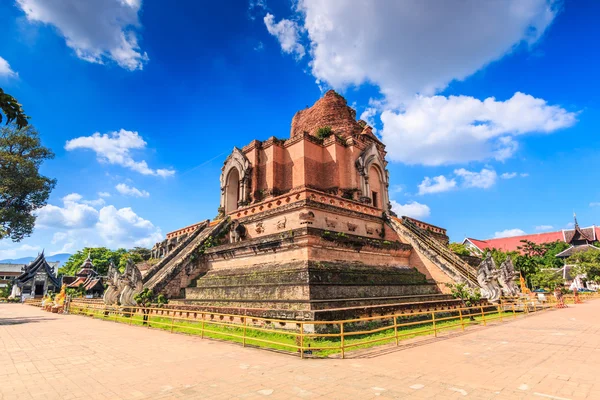
In the heart of the old city, Wat Chedi Luang houses the most imposing structure in all of Chiang Mai, even though it is only half of what it once was. Construction of the great chedi began in 1391, when King Saenmueangma wanted to create a monument to house his father's ashes. The work progressed slowly -- structural problems delayed construction for decades -- until it was finally completed in the mid-15th century under King Tilokaraj. The result was colossal: a stupa 82 meters tall with a 54-meter diameter base, the tallest building in all of the Lanna Kingdom.
In 1468, the Emerald Buddha -- the most revered Buddha image in Southeast Asia, now housed in Bangkok's Grand Palace -- was installed in a niche on the east side of the chedi. But the glory was short-lived. In 1545, a devastating earthquake toppled the upper 30 meters of the structure, also destroying several of the stone elephants that decorated the base. The Emerald Buddha was moved to Luang Prabang in 1551 and never returned. Today, the truncated stupa rises approximately 52 meters, and authorities have decided to leave it as is, without rebuilding the top, partly because nobody knows for certain what the original spire looked like. The ruins have a melancholic beauty that photographs fail to capture: stone darkened by centuries, fig tree roots forcing their way through cracks, elephant fragments eroded by time.
Wat Chedi Luang is also one of the best places in Chiang Mai to join a Monk Chat, the informal conversation sessions with Buddhist monks. The program runs daily, generally from 9:00 AM to 6:00 PM, and is completely free. The monks -- many of them young students -- practice their English while visitors learn about Buddhism, meditation and monastic life. There is no fixed script: you can talk about philosophy, football or life in general. Conversations typically last between 30 minutes and an hour, and they leave an impression that is hard to forget. Temple entry costs 40 baht.
Wat Phra Singh: the jewel of Lanna architecture
If Wat Chedi Luang impresses with its size, Wat Phra Singh wins hearts with its elegance. Located at the end of Ratchadamnoen Road, the main artery of the old city, this temple is considered the finest example of classic Lanna architecture in existence. Construction began in 1345, when the fifth king of the Mengrai dynasty, Phayu, decided to build a temple to house the ashes of his father, King Kham Fu. It was originally called Wat Li Chiang Phra, but in 1367, when the Phra Singh Buddha image was brought here, the temple adopted its current name.
The history of the Phra Singh Buddha is fascinating. According to chronicles, the statue traveled from the Mahabodhi Temple in India, passing through Sri Lanka, Nakhon Si Thammarat and Ayutthaya before reaching Chiang Mai. It is a pure Lanna-style image with the serene features and broad shoulders characteristic of northern Thai Buddhist sculpture. It is housed in the Lai Kham Viharn, a small chapel whose interior walls are covered with 19th-century murals depicting scenes of everyday Lanna life and jatakas (tales of the Buddha's previous lives). These murals are considered among the finest in Thai art.
The temple suffered a long period of neglect during Burmese domination, between the 16th and 18th centuries. In the 1920s, the revered monk Khruba Srivichai -- a figure venerated throughout northern Thailand -- supervised an exhaustive restoration that returned the temple to its splendor. Today, Wat Phra Singh functions as an active temple where ceremonies are held daily and where, during the Songkran festival in April, the Phra Singh Buddha image is carried in procession through the city streets to be bathed in scented water.
Wat Chiang Man: where it all began
This is the oldest temple in Chiang Mai, founded by King Mengrai himself in 1296, the same year he established the city. According to historical records, Mengrai resided at this location -- then known as Baan Chiang Man -- while overseeing the construction of his new capital. A stone stele found in the temple's ubosot, dated 1581, confirms that April 12, 1296 was the founding date of Chiang Mai, making Wat Chiang Man a living historical document.
The temple's most striking feature is the Chedi Chang Lom, the "elephant chedi": a stupa with a square base whose second level features the life-sized busts of 15 elephants, sculpted in brick and stucco, that appear to emerge from the structure as if supporting it on their backs. It is a powerful image not easily forgotten. The temple also houses two extraordinary Buddha images: the Phra Sila, a marble bas-relief believed to have been carved in Sri Lanka over a thousand years ago, and the tiny Phra Sae Tang Khamani, a rock crystal Buddha of barely 10 centimeters that, according to tradition, was crafted for the king of Lopburi around 200 AD. Both images are considered spiritual guardians of the city.
Wat Phan Tao: the teak wood temple
Right next to Wat Chedi Luang, Wat Phan Tao is one of Chiang Mai's most photogenic temples yet goes surprisingly unnoticed by many tourists. Its name means "temple of a thousand kilns," a reference to the foundry workshops that once existed here and produced Buddha images. The temple's star is its viharn, an assembly hall built entirely of teak wood: 21 meters long, 11 wide and 14 high, supported by 28 wooden pillars. This building was not always a temple: it was originally a ho kham, a royal palace that served as the residence of Mahotaraprathet, the fifth ruler of Chiang Mai, between 1846 and 1854. It was moved to its current location in 1876.
Above the main door is a peacock carved in wood and decorated with glass, a symbol of northern nobility. Inside, the principal image, Phra Chao Phan Tao, was cast in 1498. The entire complex has a different feel from the rest of Chiang Mai's temples: the dark wood gives it a warmth that contrasts with the brilliant gold of its neighbors, and the atmosphere is noticeably quieter. Entry is free.
Temple etiquette: the unwritten rules
Visiting temples in Thailand does not require being Buddhist, but it does require respect. The basic rules are simple but non-negotiable. Dress modestly: shoulders and knees covered, for both men and women. Many temples provide complimentary sarongs at the entrance, but not all. Remove your shoes before entering any temple building. Do not point your feet toward a Buddha image or a monk: in Thai culture, feet are considered the most impure part of the body. Women should not touch monks or hand objects to them directly; items must be placed on a cloth or an intermediate surface.
Photos are generally allowed, but without flash and with common sense. If people are praying, do not stand in front of them to photograph a statue. In meditation areas, silence your phone. And if you wish to make an offering -- lotus flowers, incense, candles -- do so with both hands and a small bow. Nobody expects a tourist to follow every protocol perfectly, but the effort is noticed and appreciated.
Monk Chat: conversations that shift perspectives
One of Chiang Mai's most unique programs is the Monk Chat, available at several temples but especially popular at Wat Chedi Luang, Wat Suan Dok and Wat Umong. The concept is simple: Buddhist monks -- many of them young students -- sit at outdoor tables and invite visitors to chat with them. For the monks, it is an opportunity to practice English. For visitors, it is a direct window into monastic life and Buddhist philosophy.
There is no script, no agenda, no cost. You can talk about anything: meditation, the meaning of suffering in Buddhism, life in a monastery, but also everyday topics. The monks are curious about the outside world and ask questions about life in other countries with a disarming frankness. Sessions typically last between 30 minutes and an hour, and many travelers describe them as one of the most memorable moments of their trip. The only requirement is to dress respectfully. There are voluntary donation boxes, but there is no pressure whatsoever.
The Sunday night market and life around the temples
Every Sunday, Ratchadamnoen Road transforms into the Sunday Walking Street, a night market that starts at Tha Pae Gate and stretches 1.1 kilometers to the doors of Wat Phra Singh. From 4:00 PM until midnight, the street fills with handmade craft stalls, street food and local musicians. What makes it special is that the market integrates with the temples: Wat Phan Tao and Wat Chedi Luang sit directly on the route, and their courtyards fill with food stalls and traditional performances. It is the best way to experience the intimate relationship between religious life and daily life in Chiang Mai.
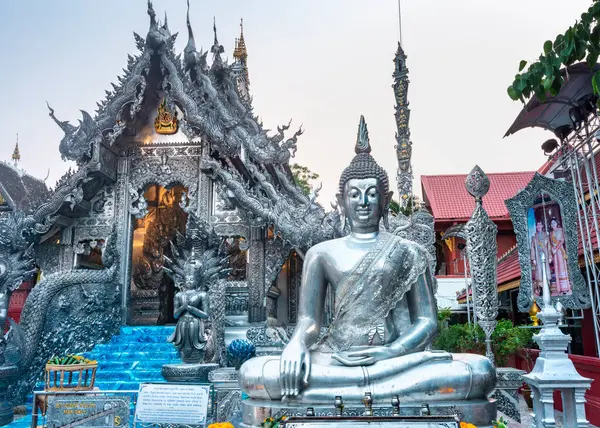
The Night Bazaar, meanwhile, operates every evening along Chang Khlan Road, east of the old city. It is more touristic than the Sunday market but remains a lively place to dine on khao soi -- the curry noodle soup that is Chiang Mai's signature dish -- and buy souvenirs. Nearby is also Wat Sri Suphan, the so-called "silver temple," whose chapel is entirely covered with aluminum and silver panels crafted by artisans from the Wua Lai neighborhood, a community with centuries of tradition in precious metalwork.
Beyond the main temples
Chiang Mai has so many temples that, beyond the big five, it is worth exploring some lesser-known ones. Wat Umong, on the city's outskirts, was built in the 14th century and is famous for its underground tunnels where monks meditated without distractions, surrounded by forest and a peaceful lake. Wat Suan Dok, founded by King Kue Na in 1370 as a royal flower garden, stands out for its cluster of whitewashed chedis housing the ashes of Chiang Mai's royal family: at sunset, with the mountains as a backdrop, the place has a breathtaking beauty.
When to visit and practical tips
The best time is between November and February, with pleasant temperatures (15-30 degrees Celsius) and little rain. March and April coincide with Songkran, the Thai New Year, which transforms the city into a water festival. Most temples in the old city can be covered on foot, but it is best to spread visits over two or three days to avoid temple fatigue. A bicycle is the most practical way to get around the center, and for Doi Suthep the most affordable option is sharing a songthaew (Chiang Mai's iconic red truck) from the base of the mountain.
If you are planning your visit to Chiang Mai, our Chiang Mai weekend guide includes detailed temple maps, updated schedules, optimized walking routes and restaurant recommendations near each wat so you do not waste time searching.
Comments
Get the best travel tips
Subscribe to the Omyguide blog and never miss an article.
No spam. Unsubscribe anytime.