Istanbul's Grand Bazaar: the market that's been selling for 570 years
61 covered streets, 4,000 shops and 400,000 daily visitors. The world's oldest commercial labyrinth, next to the Byzantine underground cistern.
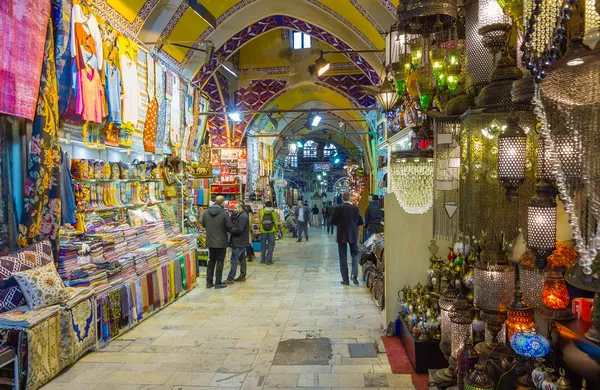
Most traditional markets have closed or become museumified tourist attractions. Istanbul's Grand Bazaar did exactly the opposite: it kept selling non-stop since 1461 and absorbed tourism as one more layer of its commercial DNA. The result is a labyrinth of 61 covered streets, 4,000 shops, 35,000 employees and between 250,000 and 400,000 daily visitors who come to buy Persian carpets, Iznik ceramics, Turkish lamps, spices, gold jewelry, tanned leather and all kinds of objects that oscillate between genuine craftsmanship and industrial souvenirs. It's noisy, chaotic, overwhelming and deeply functional. It's not a historical reconstruction: it's a living market that happens to be five and a half centuries old. And a five-minute walk away is the Basilica Cistern, a Byzantine underground palace with 336 marble columns that stored water when Justinian ruled from Constantinople. Together they form the commercial and historical heart of the Sultanahmet neighborhood, Istanbul's old town.
The Grand Bazaar: 61 streets that started with one building
The bazaar began in winter 1455, two years after Sultan Mehmed II conquered Constantinople and ended the Byzantine Empire. The sultan ordered the construction of a bedesten, a fortified commercial building dedicated to the trade of textiles and jewelry, near his palace. The central structure was completed in 1461 and was endowed as a waqf (religious foundation) to the Hagia Sophia mosque, ensuring that the market's income financed the maintenance of the city's most important religious building. That combination of commerce, religion and political power turned the bazaar into a permanent institution.
During the 16th century, under the reign of Suleiman the Magnificent, the bazaar expanded massively. New streets, caravanserais (merchant inns), Turkish baths and artisan workshops were added. The market grew organically, absorbing adjacent buildings, connecting squares and forming a labyrinthine network that responded more to commercial logic than urban planning. Each street specialized in a guild: jewelers, tanners, carpet sellers, spice merchants, lamp makers. That guild structure is still perceived today, although diluted by touristification and product diversification.
The bazaar suffered recurrent fires throughout the centuries due to wooden roofs and oil lamps. The 1894 earthquake caused severe structural damage, and the Ministry of Public Works supervised repairs until 1898, reinforcing brick vaults and consolidating arches. Today, the Grand Bazaar occupies 30,700 square meters under roof, distributed over 61 covered streets with barrel vaults painted yellow, blue and red. Turkish crystal lamps in colored glass hang from the ceilings, creating a diffused light that mixes tradition and electricity. Vendors speak Turkish, English, Arabic, German, Russian and Chinese with commercial fluency. Bargaining remains the sales protocol, although prices are increasingly standardized for passing tourism. Still, the bazaar is not a stage: it's a real market where local Istanbulites also buy gold, repair antique watches, order custom suits and drink tea with lifelong merchants.
The Basilica Cistern: 336 columns underground
500 meters from the Grand Bazaar, beneath the streets of Sultanahmet neighborhood, extends one of Istanbul's most unsettling architectural spaces: the Basilica Cistern, an underground cathedral built to store water. It was built in 532 AD by order of Byzantine Emperor Justinian I, at the height of the Byzantine Empire. Its function was practical and strategic: to guarantee water supply to the Great Palace of Constantinople in case of siege. The city depended on the Valens Aqueduct to bring water from the mountains, but that system was vulnerable to military attacks. The cistern allowed storing enough reserves to withstand long sieges without running out of drinking water.
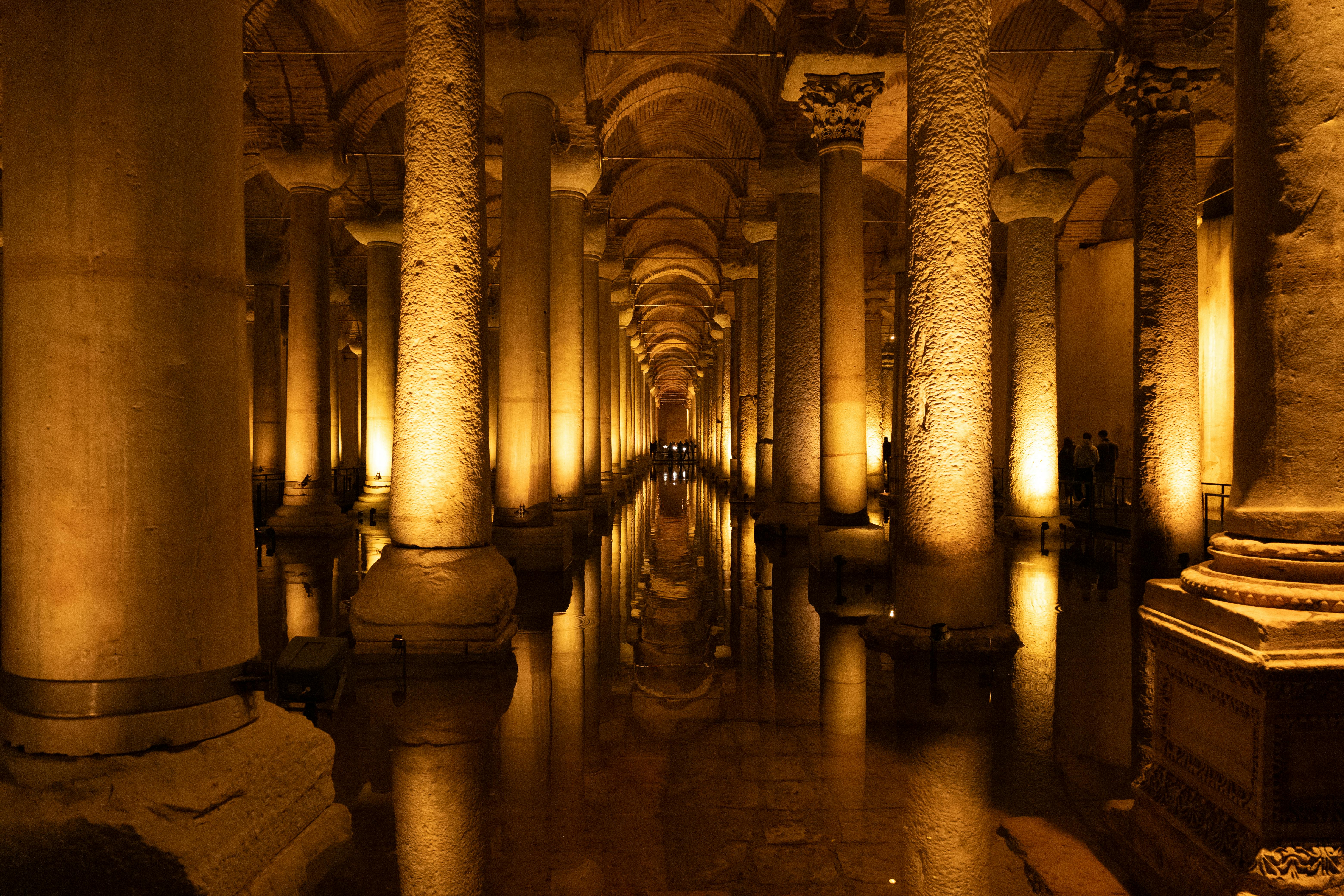
The cistern has 336 marble columns, each approximately 9 meters high, arranged in 12 rows of 28 columns. The columns come from demolished or abandoned ancient temples around Constantinople, which explains why they have mixed architectural styles: Corinthian, Ionic, Doric. Some have capitals carved with vegetal motifs; others are completely smooth. Material recycling was common in Byzantine construction, and the cistern is an involuntary catalog of Greco-Roman classical architecture plundered to build the new Christian capital.
The cistern's most famous element is the two Medusa heads that serve as column bases in the northwest corner. One is sideways; the other, inverted. It's not known for certain why they're in that position. The most accepted theory is functional: the heads were reused pedestals from some pagan temple, and were placed inverted simply to adjust the necessary height as a column base. Another, more symbolic interpretation suggests that inverting Medusa's image neutralized her mythological power to turn to stone whoever looked at her. Whatever the reason, the heads have become the visual symbol of the cistern, and tourists crowd on wooden walkways to photograph them reflected in the illuminated water.
After the Ottoman conquest in 1453, the cistern fell into disuse. The Ottomans preferred running water systems and the cistern was forgotten for centuries. Neighborhood residents knew there was an underground chamber because they fished through holes in their basement floors, but didn't know its extent. It was rediscovered in 1545 by French scholar Petrus Gyllius, who was researching Byzantine antiquities in Istanbul. Today, the cistern is an underground museum with dramatic lighting, ambient music and elevated walkways that allow walking among the columns over shallow water. It's one of Istanbul's most cinematic spaces, and has appeared in films like James Bond's «From Russia with Love».
How to navigate the Grand Bazaar without getting (too) lost
The Grand Bazaar has 22 access gates, but the two main ones are the Beyazıt Gate (west side, near Istanbul University) and the Nuruosmaniye Gate (east side, near the mosque of the same name). The main street is Kalpakcılar Caddesi, which connects both gates and is flanked by gold and silver jewelry shops. It's the bazaar's busiest commercial artery and the clearest orientation axis. If you get lost, look for that street and you can reorient yourself toward one of the main gates.
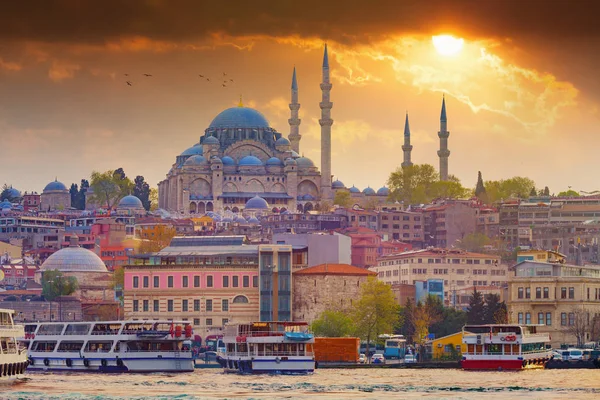
Inside the bazaar, the İç Bedesten is the original historical core, the 15th-century building that gave rise to the entire complex. Today it houses antique shops, antique carpets, Ottoman coins, calligraphic manuscripts and collectibles. Prices here are significantly higher than in the rest of the bazaar, but quality usually is too. If you're looking for authentic Iznik ceramics (not industrial reproductions), hand-tanned leather or artisanal blown glass Turkish lamps, this is the area to ask.
The bazaar is open Monday to Saturday from 8:30 to 19:00. It's closed on Sundays and the first day of Islamic religious holidays. Entrance is free: there are no ticket offices or access controls, you simply walk in like any shopping street. The best time to visit is early morning, between 9 and 11, when there are fewer tourists, merchants are opening their shops and the atmosphere is more relaxed. From noon onwards, especially between April and October, the bazaar gets saturated with tour groups and the noise, heat and overwhelm increase exponentially.
If you're going to buy something valuable (carpet, jewelry, expensive ceramics), bargaining is expected and practically mandatory. The initial price is usually inflated between 30% and 50% over the actual selling price. The tactic is simple: show interest, ask the price, react as if it were excessive, offer half, let the seller counteroffer, negotiate to a middle point and, if it doesn't convince you, start walking away. In 80% of cases, the seller will call you back with a lower price. If you really want the object, don't rush: have tea, ask about provenance, establish conversation. Bargaining at the Grand Bazaar is not just economic transaction; it's a social ritual that can last ten minutes or half an hour depending on price and the relationship you establish with the seller.
Istanbul's commercial heart, five centuries later
The Grand Bazaar is not Istanbul's prettiest market, nor the most authentic, nor the least touristy. Those titles probably belong to the Spice Market (Mısır Çarşısı) or neighborhood bazaars like Kadıköy. But the Grand Bazaar is the most historical, the largest and the one that best summarizes Istanbul's commercial continuity: a city that's been a crossroads between Europe, Asia and the Middle East for 2,000 years, and continues selling what it always sold, only now also to Japanese with cameras, Russians buying gold and Europeans looking for carpets. Combining it with the Basilica Cistern the same morning is an efficient way to understand two faces of Istanbul: the superficial, noisy and commercial; and the underground, silent and monumental. Both are equally real.
If the Grand Bazaar and Basilica Cistern have made you want to explore more historical corners of Istanbul and Turkey, our 7-day Turkey guide includes complete routes with Google Maps, day-by-day itineraries, inter-city transport, monument schedules and all practical details to travel from Istanbul to Cappadocia via Ephesus and Pamukkale.
Comments
Get the best travel tips
Subscribe to the Omyguide blog and never miss an article.
No spam. Unsubscribe anytime.