The Forbidden City in Beijing: History, Secrets and Complete Guide to the World's Largest Palace
Complete guide to Beijing's Forbidden City: 500 years of imperial history, 24 emperors, architecture, symbolism and practical tips for your visit.
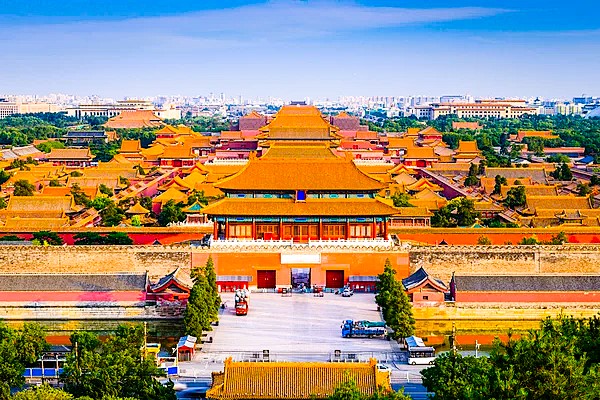
There are few places on Earth where history is felt with such intensity as in Beijing's Forbidden City. This 720,000-square-meter palace complex, declared a UNESCO World Heritage Site in 1987, is not just the largest imperial palace ever built: it is a universe unto itself, a city within a city where for 500 years the fate of the world's oldest civilization was decided. Every stone, every glazed tile, every dragon carved into its columns tells a chapter of a story that began in 1406 and today attracts more than 17 million visitors a year.
Why Is It Called the Forbidden City
The Chinese name, Zijincheng (紫禁城), literally translates as 'Purple Forbidden City'. The purple reference does not allude to the color of its walls, but to the Ziwei constellation, centered on the Pole Star, which in Chinese cosmology represented the abode of the Celestial Emperor. Just as the Pole Star remained fixed in the sky while all other stars revolved around it, the earthly emperor was to remain immobile at the center of his palace while the empire moved around him.
The term 'forbidden' was literal: from its inauguration in 1420 until the fall of the last emperor in 1912, access was denied to anyone without explicit imperial authorization. Commoners who attempted to cross its gates faced the death penalty. For nearly five centuries, the vast majority of the Chinese population never saw what lay behind those 10-meter-high crimson walls, further protected by a 52-meter-wide moat.
The Construction: A Colossal Undertaking
In 1406, Emperor Yongle (朱棣), the third ruler of the Ming dynasty, ordered the construction of a new imperial palace in Beijing. Yongle had usurped the throne from his nephew and needed to move the capital from Nanjing to Beijing to consolidate his power in the north and defend the frontier against the Mongols. The undertaking was colossal: more than one million workers were mobilized, including 100,000 specialized artisans.
Precious nanmu wood arrived from the jungles of Yunnan and Sichuan, transported for months along rivers and canals. White marble blocks were quarried from sites outside Beijing; the largest piece, a 16-meter-long ramp weighing 250 tons now behind the Hall of Preserving Harmony, was moved in winter by sliding it over artificial ice created by pouring water on the frozen road. The famous 'golden bricks' for the main hall floors were fired for months in special kilns in Suzhou province until they acquired a metallic sheen and rang like bells when struck.
Construction lasted 14 years. In 1420, Emperor Yongle officially inaugurated the Forbidden City as the new imperial capital. However, just months after the inauguration, lightning destroyed the three main halls, which many interpreted as a sign of celestial disapproval. The halls were rebuilt, but this would not be the last time: fires, rebellions and the passage of centuries forced the reconstruction of multiple structures throughout history.
24 Emperors and Two Dynasties
Throughout its history as an imperial residence, the Forbidden City housed 24 emperors: 14 from the Ming dynasty (1420-1644) and 10 from the Qing dynasty (1644-1912). The first was Yongle himself. The last, the child emperor Puyi, who ascended the throne in 1908 at just three years of age.
The transition between dynasties was dramatic. In 1644, the rebel army of Li Zicheng took Beijing and the last Ming emperor, Chongzhen, hanged himself on Coal Hill (today's Jingshan Park), just behind the Forbidden City. Weeks later, the Manchus from the north entered Beijing with the help of General Wu Sangui and established the Qing dynasty, which would rule from these same halls for the next 268 years.
Under the Qing, the Forbidden City experienced its period of greatest splendor with emperors like Kangxi, who reigned for 61 years, and Qianlong, who embellished it with gardens and art collections. But it also experienced its decline: the Opium Wars, the invasion by Western powers in 1900 during the Boxer Rebellion, and the growing weakness of the court gradually eroded imperial power. After the Revolution of 1911, Emperor Puyi abdicated in February 1912, marking the end of more than two millennia of imperial rule in China.
The Last Emperor and the 1924 Expulsion
Although Puyi formally abdicated in 1912, he was allowed to continue living in the inner part of the Forbidden City under the 'Articles of Favorable Treatment' negotiated with the new republic. The young Puyi continued to lead a privileged life within the palace walls, surrounded by eunuchs and courtiers, oblivious to the rapidly changing outside world.
That situation ended abruptly on November 5, 1924, when warlord Feng Yuxiang staged a coup, abolished the imperial privileges and expelled Puyi from the palace. He was given barely three hours to leave the premises. Puyi first took refuge at his father Prince Chun's residence, then at the Japanese legation, a move that would have tragic consequences: years later, the Japanese would install him as puppet emperor of the state of Manchukuo. A year after Puyi's expulsion, in October 1925, the Forbidden City opened its doors as the Palace Museum (故宫博物院), allowing the Chinese people for the first time to see what had been denied to them for centuries.
The Architecture: 980 Buildings and 8,728 Rooms
According to the official 1973 survey, the Forbidden City contains 980 surviving buildings with 8,728 rooms, though a later recount in 2012 raised the figure to 1,200 buildings and 9,371 rooms. The complex is organized along a north-south axis of nearly one kilometer, following feng shui principles: the palace faces south to receive positive energy, while to the north, the artificial Coal Hill protects it from cold winds and evil spirits coming from the north.
The Forbidden City is divided into two major zones: the Outer Court (Waichao), for state ceremonies, and the Inner Court (Neiting), the private residence of the emperor and his family.
The Outer Court
The ceremonial heart of the complex consists of three monumental halls aligned along the central axis. The Hall of Supreme Harmony (太和殿, Taihe Dian) is the largest and most important building in the Forbidden City. At 2,377 square meters with a golden throne flanked by columns carved with dragons, it was the setting for the most solemn ceremonies: coronations, imperial weddings, Lunar New Year celebrations and the reception of foreign ambassadors. It is the largest surviving wooden structure in China.
Behind it stands the Hall of Central Harmony (中和殿, Zhonghe Dian), a more intimate space where the emperor prepared and rested before grand ceremonies. The third hall, the Hall of Preserving Harmony (保和殿, Baohe Dian), served as the setting for imperial banquets and, crucially, as the venue for the final imperial examinations, the highest selection competition for the Chinese bureaucracy. Passing this exam was every Chinese scholar's dream, as it meant access to the highest government positions.
The Inner Court
Beyond the Gate of Heavenly Purity begins the emperor's private world. The Palace of Heavenly Purity (乾清宫, Qianqing Gong) was the emperor's official residence during the Ming dynasty. Here he slept, read memorials from his ministers and made daily government decisions.
However, from Emperor Yongzheng (reign 1722-1735), the imperial residence moved to the Hall of Mental Cultivation (养心殿, Yangxin Dian), a more modest but more functional building where the last eight Qing emperors lived and governed. Here, behind a silk curtain, Empress Dowager Cixi wielded de facto power for decades, one of the most powerful and controversial figures in Chinese history.
The Imperial Garden
At the northern end of the complex, the Imperial Garden (御花园, Yuhuayuan) offered the imperial family a haven of peace with its centuries-old cypresses, artificial rockeries, ponds with goldfish and pavilions for enjoying tea or contemplating the moon. Despite its relatively modest size (12,000 square meters), the garden is a compendium of Chinese landscape aesthetics, with every rock, plant and path carefully arranged to create visual harmony.
The Hidden Language: Imperial Symbolism
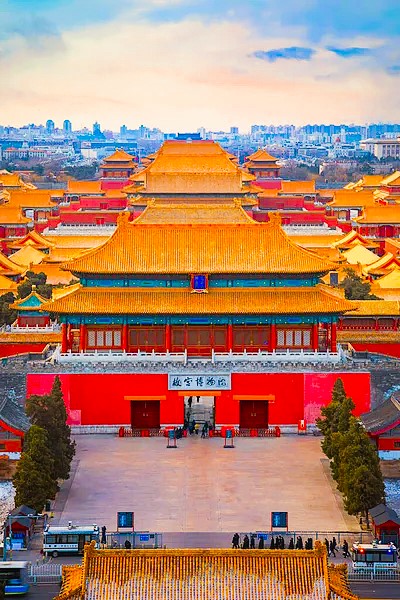
Every element of the Forbidden City is laden with meaning. The number 9 (九, jiu), homophonic with the word for 'eternity' in Chinese, appears everywhere: the main gates have 81 studs (9x9), the roofs of the main halls display 9 mythical animal figures, and the great marble ramp is decorated with 9 dragons. The yellow color of the glazed tiles was exclusive to the emperor, symbolizing the center of the universe according to Five Elements theory. The only building with green tiles is the library, as green represents wood and, by extension, protection against fire.
Dragons, the symbol of the emperor, number in the thousands: it is estimated that there are more than 12,000 representations of dragons throughout the complex. The phoenix, symbol of the empress, frequently appears alongside the dragon. Bronze and stone lions guard the entrances: the male with a ball under its paw (symbolizing power over the world) and the female with a cub (symbolizing the dynasty's fertility).
The Palace Museum: A Treasure for Humanity
Since its opening in 1925, the Palace Museum has become one of the most visited museums on the planet, with 17.6 million visitors recorded in 2024. Its collections hold approximately 1.86 million pieces, including paintings, calligraphy, ceramics, bronzes, jades, clocks and artifacts from daily imperial life.
Among the most notable exhibitions are the Clock Gallery, with ingenious mechanical pieces that Jesuit missionaries and European diplomats gave as gifts to the Qing emperors; the imperial ceramics exhibition, tracing the evolution of Chinese porcelain from the Song to the Qing dynasty; and the jade and jewelry galleries, featuring pieces of extraordinary delicacy carved over centuries for the imperial family.
In December 2025, the museum reopened the Hall of Mental Cultivation section after a decade-long restoration, returning to the public one of the most significant spaces of Qing imperial power.
The Forbidden City and Tiananmen Square
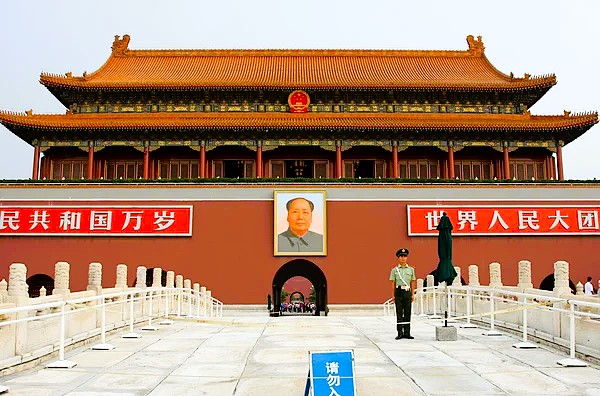
The Forbidden City and Tiananmen Square form an inseparable ensemble at the heart of Beijing. The square extends directly south of Tiananmen Gate (天安门, 'Gate of Heavenly Peace'), the official entrance to the imperial complex. This gate, with its portrait of Mao Zedong, is probably the most iconic image of contemporary China.
Both spaces form part of Beijing's Central Axis, a 7.8-kilometer historic corridor connecting the Forbidden City with the Temple of Heaven to the south and the Drum and Bell Towers to the north. This central axis was inscribed by UNESCO as a World Heritage Site in 2024, recognizing its extraordinary value as an example of imperial urban planning.
Practical Tips for Your Visit
Opening hours: The Forbidden City is open Tuesday through Sunday. From April to October, hours are 8:30 AM to 5:00 PM (last entry at 4:00 PM). From November to March, 8:30 AM to 4:30 PM (last entry at 3:30 PM). Closed every Monday except during national holidays.
Tickets: Admission costs 60 yuan (approximately 7.50 euros) in peak season (April-October) and 40 yuan (about 5 euros) in low season (November-March). Special exhibitions like the Clock Gallery and the Treasure Gallery cost an additional 10 yuan each. Tickets must be purchased in advance on the official website (https://intl.dpm.org.cn/) as there is a daily limit of 40,000 visitors and they sell out quickly.
Recommended duration: A complete visit requires 3 to 5 hours. The minimum route along the central axis (south to north) takes about 2-3 hours, but exploring the side palaces, gardens and exhibitions can easily fill half a day.
Best route: Enter through the Meridian Gate (Wumen) to the south and walk the central axis northward. If you have time, detour west to the Hall of Mental Cultivation, and east to the Clock Gallery. Exit through the Gate of Divine Prowess (Shenwumen) to the north and climb Jingshan Park for the best panoramic view of the complex: from its artificial hill, the golden rooftops stretch to the horizon in an image that encapsulates the grandeur of imperial China.
Key tip: Arrive early, at opening time. Crowds concentrate in the Outer Halls by mid-morning. If you enter at 8:30 AM, you will have a few minutes of relative calm to photograph the Hall of Supreme Harmony without thousands of heads in the foreground.
If the Forbidden City has sparked your curiosity, in our 5-day Beijing guide you will find day-by-day itineraries with Google Maps, recommended restaurants by area, practical transport information and the best routes to explore the Chinese capital.
Comments
Get the best travel tips
Subscribe to the Omyguide blog and never miss an article.
No spam. Unsubscribe anytime.