Montmartre: the bohemian village on top of Paris
Street artists, legendary cabarets and a white basilica overlooking the city. A guide to discovering Montmartre beyond the clichés.
There is something about Montmartre that does not quite fit with the rest of Paris. Maybe it is the slope of its streets, which forces you to walk slowly. Maybe it is the steep staircases that replace Baron Haussmann’s straight avenues. Or maybe it is that this neighborhood, perched on the highest hill in the city at 130 meters above the Seine, was an independent commune for centuries — it was not annexed by Paris until 1860 — and still carries the air of a village resisting the metropolis. Montmartre smells of freshly made crepes, sounds like an accordion and looks like an oil painting from the thousand canvases propped on easels at the Place du Tertre. It is a cliché, yes, but it works because underneath there is something real: a history of artists, rebels and dreamers who turned this hill into the epicenter of modernity.
The Sacré-Cœur: the basilica that whitens in the rain
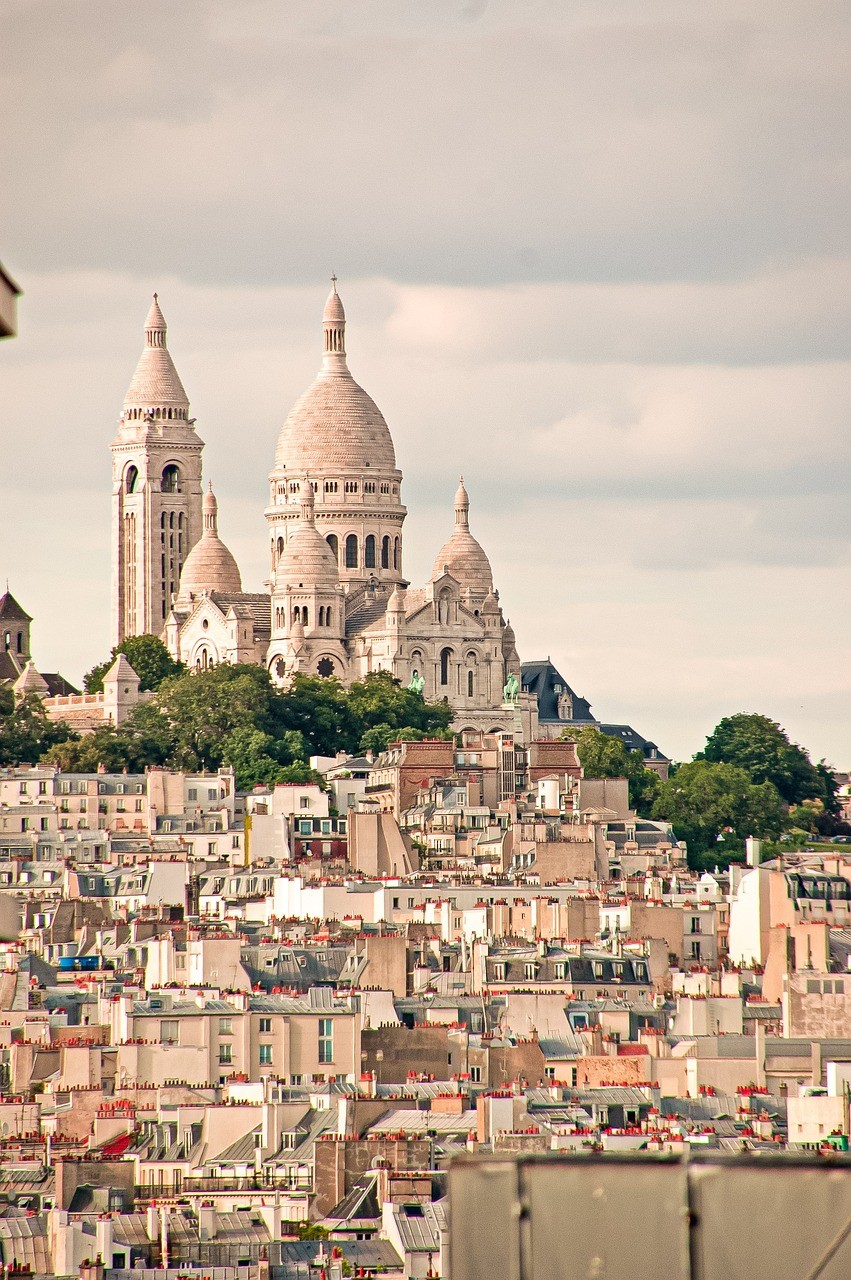
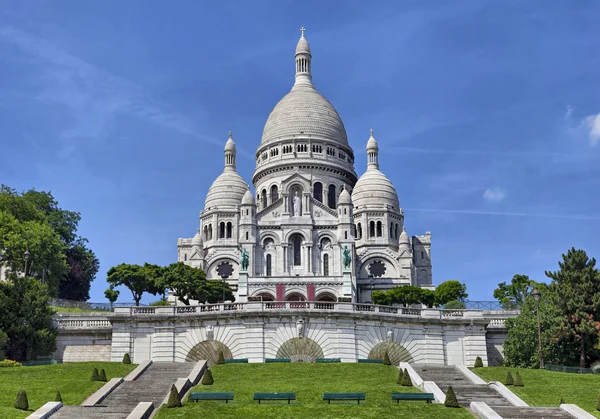
The Basilica of the Sacré-Cœur dominates the Parisian skyline from the top of Montmartre like a colossal meringue. Construction began in 1875, after the defeat in the Franco-Prussian War and the violence of the Paris Commune, as an act of national atonement — although many Parisians at the time considered it an insult to the memory of the communards executed on that very hill. The works lasted nearly forty years and the basilica was not consecrated until 1919. Its Romano-Byzantine style, with domes that recall Istanbul more than Paris, was controversial from the first sketch. But the most curious thing about the building is its material: travertine stone from Château-Landon, which has a unique property — on contact with rain it secretes calcite, so the basilica whitens with every downpour instead of darkening. It is a building that cleans itself. From the esplanade one of the best panoramic views of Paris unfolds, and if you climb the 300 steps to the dome, on clear days the view reaches forty kilometers in every direction.
Place du Tertre and the artistic legacy
Two hundred meters from the Sacré-Cœur, the Place du Tertre has been an open-air art market since the eighteenth century. Today a maximum of 298 artists authorized by the city council take turns painting and selling their work in this tiny square, barely 1,400 square meters where easels compete with café terraces. It is easy to dismiss it as a tourist trap, but the tradition is legitimate: it was here, in the surrounding streets, that much of modern art was forged. Van Gogh lived in Montmartre between 1886 and 1888, in an apartment on rue Lepic with his brother Theo, and during those two years he painted more than two hundred works, discovered the vivid colors that would define his art and immersed himself in the impressionism bubbling through the neighborhood cafés. A few years later Picasso settled in the Bateau-Lavoir, a ramshackle communal studio on rue Ravignan where in 1907 he painted Les Demoiselles d’Avignon, the canvas that blew apart the rules of Western painting and opened the door to Cubism. Modigliani, Braque, Juan Gris, Toulouse-Lautrec — the roster of artists who worked on this hill reads like a summary of twentieth-century art.
The Moulin Rouge and cabaret culture
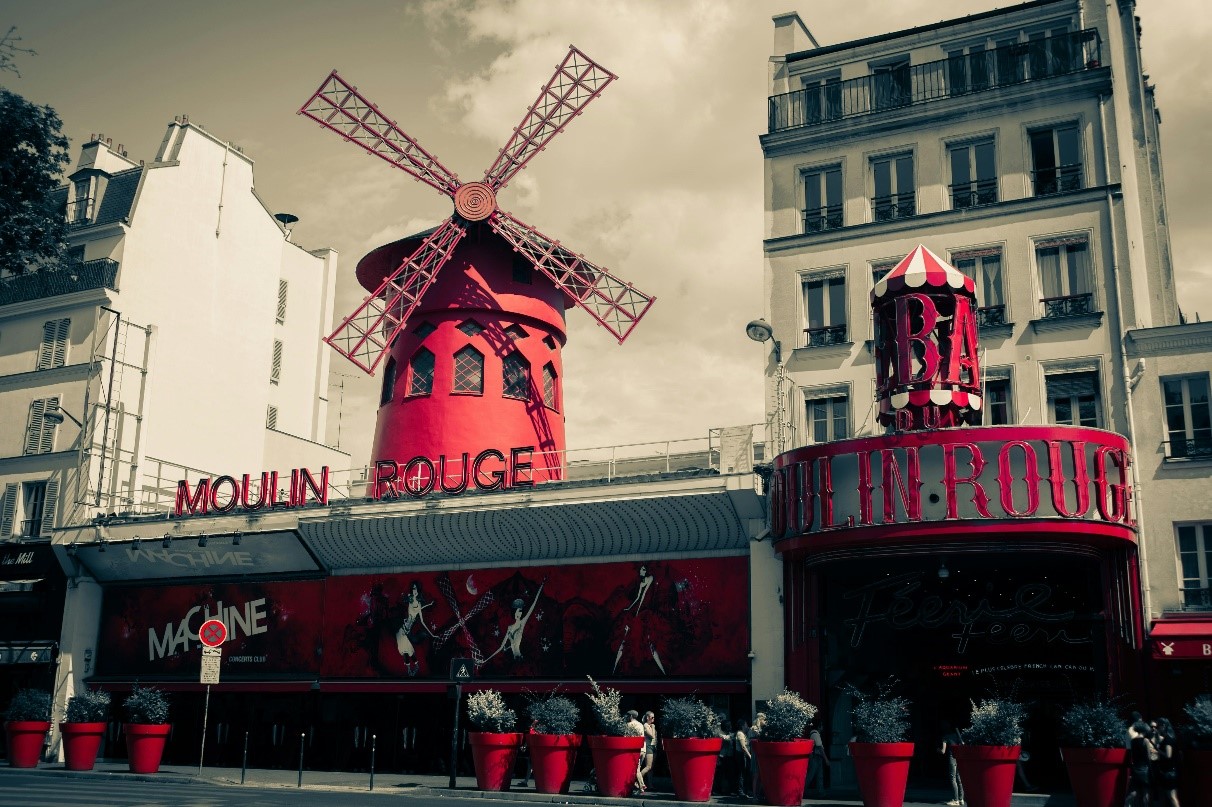
At the foot of the hill, on the Boulevard de Clichy, a red windmill has been turning since 1889, the same year the Eiffel Tower opened. The Moulin Rouge was born as a popular cabaret in the Pigalle district, where the Parisian bourgeoisie mingled with artists and prostitutes in an atmosphere of freedom that scandalized half of Europe. Toulouse-Lautrec immortalized its cancan dancers in posters that are now icons of graphic art. The venue has survived two world wars, the cinema revolution and the competition of digital entertainment, and still stages revue shows every night. Beyond the Moulin Rouge, Montmartre was the world capital of cabaret: Le Chat Noir, which opened in 1881, was the first artistic cabaret in history, a place where poets, musicians and comedians invented a performance format that is still alive across the globe.
Hidden Montmartre: vineyards, studios and secret cabarets
Mass tourism has transformed the main streets of Montmartre, but step just a hundred meters from the Place du Tertre and you find another neighborhood — quieter, more authentic, more surprising. At the corner of rue des Saules and rue Saint-Vincent hides the Clos Montmartre, one of the last vineyards in Paris. Planted in 1933 to prevent the land from becoming an apartment block, this tiny vineyard produces around 1,500 bottles a year of a wine Parisians affectionately describe as mediocre — but whose harvest every October is celebrated with a street festival filled with music and joy. A few steps away stands the Bateau-Lavoir, rebuilt after a fire in 1970 but still home to working artists, and a little further down the same rue des Saules, the cabaret Au Lapin Agile. Active since the 1860s, this tiny pink-walled venue was the meeting point of Picasso, Apollinaire and Utrillo, and still offers evenings of French songs and poetry in an atmosphere that has barely changed in a century. It is said that Picasso once paid for a dinner with a painting that would be worth millions today.
The artists' trail
Montmartre was the birthplace of modern art, and its creative ghosts remain. At the Bateau-Lavoir on Place Émile Goudeau, Picasso painted Les Demoiselles d'Avignon in an unheated room. Van Gogh lived with his brother Theo on Rue Lepic —the same building still stands, unmarked, discreet. Toulouse-Lautrec immortalized the neighborhood's cabarets in posters now worth millions. And the Espace Dalí, a gallery dedicated to the Catalan genius, hides over 300 original works in a basement near the Place du Tertre. Walking from one point to another takes no more than an hour but crosses a hundred and fifty years of artistic revolution.
Eating in Montmartre: where locals eat
Montmartre's most common tourist trap is sitting on Place du Tertre paying fifteen euros for a mediocre crêpe. Locals eat elsewhere. Rue Lepic is the neighborhood's food street: open-air market in the mornings, authentic restaurants all day. Le Consulat, with its postcard facade, serves honest French cuisine at fair prices. For the adventurous, Pink Mamma —a few minutes downhill— is a five-story Italian restaurant worth the queue. And for breakfast, any boulangerie on Rue des Abbesses beats the Instagram cafes downtown.
Practical tips for visiting Montmartre
The best time to climb Montmartre is early in the morning, before nine — the streets are empty, the light is soft and the Place du Tertre has not yet set up its easels. The Montmartre funicular, which works with a standard metro ticket, spares you the stairs of rue Foyatier, but if your legs are up to it the walk up those same steps is one of the classic Paris experiences. The most convenient metro station is Abbesses (line 12), which also has one of the prettiest Art Nouveau entrances in the system. Avoid the restaurants on the Place du Tertre — inflated prices, questionable quality — and seek out the back streets: rue Lepic, rue Norvins and the market on rue du Poteau offer far more authentic options. A complete walk through the neighborhood, without rushing, takes about three hours, and the reward is discovering that Montmartre is not just a pretty postcard: it is a slice of living history where every corner holds the trace of someone who changed the world with a paintbrush, a song or an idea.
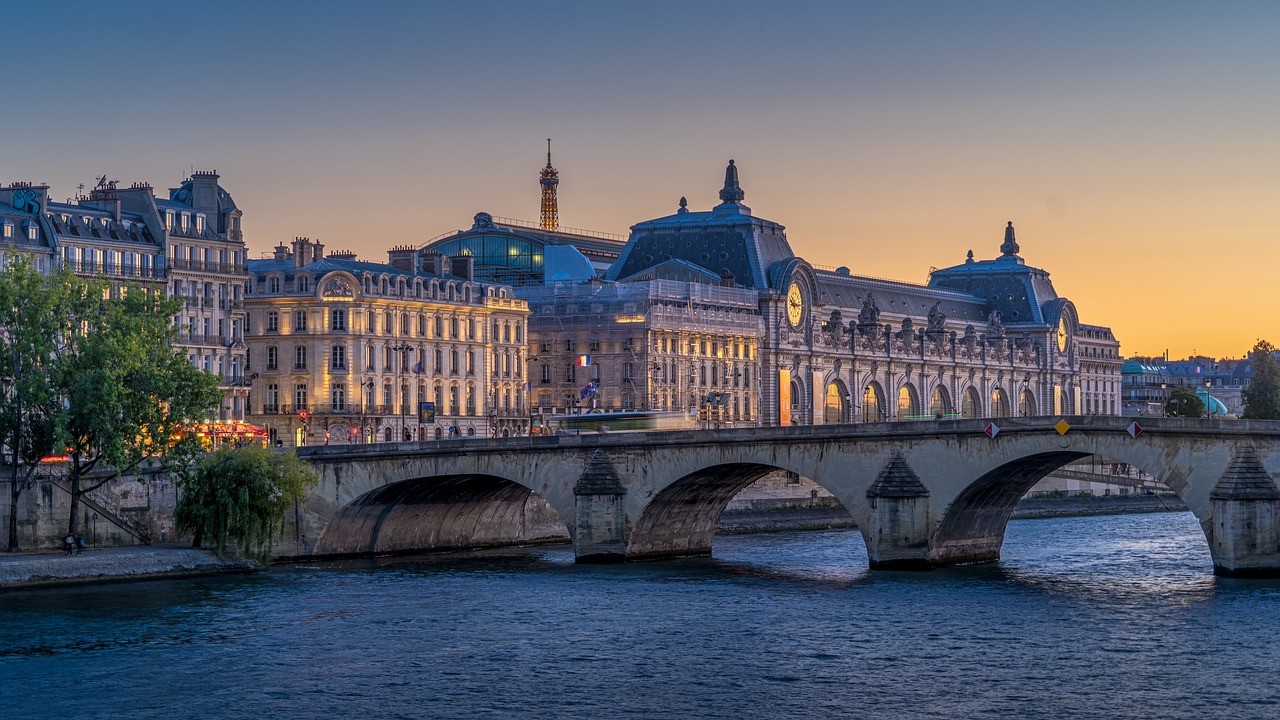
If Montmartre has sparked your curiosity about Paris, our 5-day Paris guide includes day-by-day itineraries with Google Maps, recommended restaurants by neighborhood, museum and monument opening hours, transport information and practical tips to make the most of every day without the stress.
Comments
Get the best travel tips
Subscribe to the Omyguide blog and never miss an article.
No spam. Unsubscribe anytime.