Neuschwanstein Castle: the fairy tale that inspired Disney
Discover King Ludwig II's Bavarian castle that inspired Walt Disney. History, architecture and tips for visiting Germany's most photographed castle.
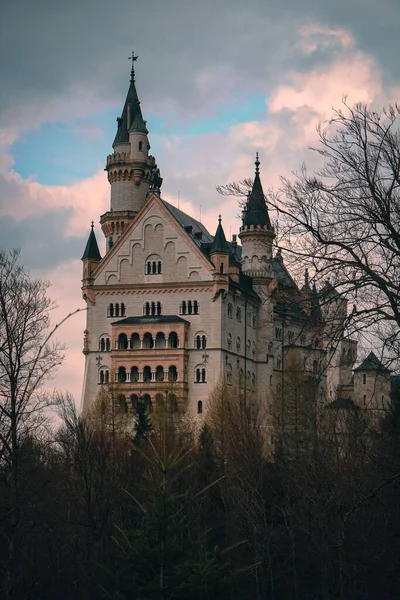
High on a cliff above the Pöllat Gorge, surrounded by the Bavarian Alps, stands Europe's most improbable castle. Its towers point skyward as if sprouted directly from a storybook, its white walls contrast with pine forests, and its silhouette has become synonymous with romantic fantasy. This is no accident: Walt Disney visited it in the 1950s and was so impressed that he used it as the model for Sleeping Beauty's Castle at Disneyland.
But Neuschwanstein is not an ancient fantasy. It's a modern fantasy, built in an era when castles no longer served defensive purposes. Its builder, King Ludwig II of Bavaria, conceived it as a personal refuge to escape political pressures and lose himself in Wagnerian operas. The result is a building that looks medieval but conceals central heating, hot running water, and flush toilets—luxuries unthinkable in authentic 13th-century castles.
Ludwig II: The Mad King Who Built a Dream
Ludwig II of Bavaria ascended to the throne in 1864 at just 18 years old. He was shy, idealistic, deeply romantic, and fascinated by Richard Wagner's operas. Politics bored him; the Austro-Prussian War of 1866 emotionally devastated him. He dreamed of building castles that would recreate the epic worlds of Wagnerian operas: Tristan and Isolde, Lohengrin, Tannhäuser.
In 1868 he ordered the construction of Neuschwanstein ("New Swan Stone") on the site of two old ruined fortresses. The project was supposed to be completed in three years. It took 17 years and was never finished. Ludwig only lived there about six months total, in short and sporadic stays, before his mysterious death in 1886.
Bavarians nicknamed him "the Mad King." He was eccentric, yes: he dined with busts of French kings as company, avoided public appearances, spent fortunes on extravagant castles. But he was also an aesthetic visionary whose "madness" now generates millions in tourism. Neuschwanstein receives 1.4 million visitors annually, making it one of Germany's three most-visited tourist attractions.
Fantasy Architecture with Modern Technology
Neuschwanstein was designed by Christian Jank, a theatrical set designer, not an architect. This explains why it looks more like a romantic stage set than a functional fortress. Its non-defensive towers, ornate windows, and perfectly symmetrical proportions are meant to be admired, not to withstand sieges.
However, beneath its medieval appearance it hides cutting-edge technological innovations for 1880:
- Forced-air central heating in all rooms
- Hot and cold running water in kitchen and bathrooms
- Flush toilets on every floor (unheard of in real castles)
- Servant call system with electric bells
- Telephone connecting different areas of the castle
The Throne Hall, inspired by Byzantine churches, stands 13 meters high and was designed to house a golden throne that was never installed—Ludwig died before completing it. The Singers' Hall imitates the Wartburg in Thuringia (where according to legend the Sängerkrieg took place that Wagner turned into opera). Each room is a tribute to medieval legends: Siegfried, Tristan, Lohengrin.
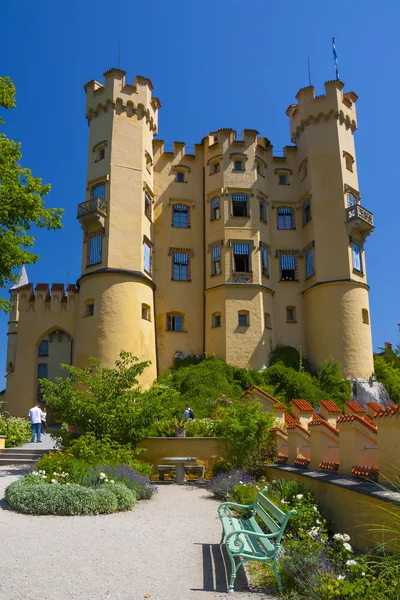
Hohenschwangau: The Yellow Castle of Childhood
Directly across from Neuschwanstein, on the other side of the valley, stands Hohenschwangau, the yellow castle where Ludwig II grew up. His father, Maximilian II, rebuilt it in neo-Gothic style when Ludwig was a child, filling it with frescoes of knights and swans.
Here Ludwig spent his childhood among murals of Lohengrin, the Swan Knight, who would later become his obsession. From Hohenschwangau's windows he could see the site where he would later build his own dream castle. Today you can visit both in a single day—the combined ticket is the most popular option.
Unlike Neuschwanstein, Hohenschwangau WAS a functional royal residence. Here you'll see how the Bavarian royal family actually lived: original furniture, personal objects, a much more intimate and less theatrical atmosphere.
How to Visit Neuschwanstein: Practical Tips
Book online in advance—it's mandatory. In summer they sell up to 6,000 tickets daily and sell out weeks ahead. The visit is ONLY by guided tour lasting 30 minutes (English available via audio guide).
Price: €15 adults, combined ticket with Hohenschwangau €31.
How to get there: From the village of Hohenschwangau (where the ticket center is located) there are three options:
- On foot: 30-40 minutes uphill (steep)
- Shuttle bus: €3 up, €2 down (drops you 10 min from castle)
- Horse-drawn carriage: €8 up, €4 down (slow but picturesque)
Marienbrücke Bridge is 10 minutes further up from the castle. It's a suspension bridge over the gorge offering THE classic photo of Neuschwanstein complete with Alps backdrop. Essential, though somewhat vertiginous.
Best time: May-October for good weather, but maximum crowds. November-April has fewer people but the bridge may close due to ice/snow. Dawn in winter, with the snow-covered castle and frozen Lake Alpsee, is magical—but you'll need to sleep in Füssen to arrive early.
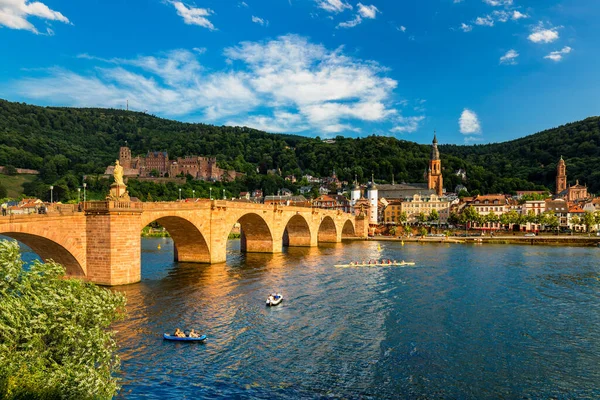
The Romantic Road: From Würzburg to Füssen
Neuschwanstein is the final jewel of the Romantic Road (Romantische Straße), a 460-km tourist route crossing Bavaria from north to south, connecting medieval walled towns, Main valley vineyards, and finally the Alps.
The official route starts in Würzburg (with its spectacular Baroque Residenz) and passes through Rothenburg ob der Tauber (Germany's most photogenic medieval town, with intact walls), Dinkelsbühl (another less-touristy walled town), Nördlingen (built inside a meteorite crater), Augsburg (Roman city with 2,000 years of history), and culminates in Füssen, gateway to Ludwig II's castles.
Covering it completely requires 5-7 days by car or 7-10 days by bicycle (the route is adapted for cyclists). But if you only have 2-3 days, focus on the southern section: Rothenburg + Neuschwanstein + Alps.
Marienbrücke: the bridge with the best view
The most iconic photograph of Neuschwanstein is taken from the Marienbrücke, a metal suspension bridge spanning the Pöllat gorge at ninety meters. From there the castle appears silhouetted against the Alps as if it were a film set. The bridge closes in winter due to ice and snow, so if you travel between November and April, the alternative is the viewpoint on the trail up the opposite slope —less known, equally spectacular. In peak season the queue to cross can exceed thirty minutes; arriving before nine or after five changes everything.
Inside the castle: rooms you cannot miss
Of the two hundred rooms planned, only fourteen were completed before Ludwig II's death. But what fourteen. The Throne Hall imitates a Byzantine church with porphyry columns and a mosaic floor of two million pieces —the throne was never installed. The Singers' Hall, inspired by Wagner's Tannhäuser, occupies the entire fourth floor and has perfect acoustics now used for concerts. The artificial grotto, with stalactites, a waterfall and colored lights, was Ludwig's most eccentric whim: a cave inside a castle. The royal bedroom required fourteen woodcarvers working four and a half years on the oak canopy.
World Heritage and Legacy
In 2025, Neuschwanstein was declared a UNESCO World Heritage Site along with other palaces of Ludwig II (Linderhof, Herrenchiemsee and Schachen). Recognition was long in coming—for decades it was considered too "modern" and "artificial" for the list—but UNESCO finally valued its importance as a masterpiece of historical romanticism and its global cultural influence.
Because Neuschwanstein's impact goes far beyond Bavaria. It directly inspired Disney's castle, yes, but it also defined our collective image of how a fairy tale castle "should look." Before Ludwig II, castles were associated with gray, functional military fortresses. After him, castles are white towers, pointed turrets, dreamlike walls.
Ludwig died under mysterious circumstances in 1886, drowned in Lake Starnberg alongside his psychiatrist. Officially it was suicide. Unofficially, many believe he was murdered by ministers who wanted to end his costly projects. Just six weeks after his death, Neuschwanstein opened to the public for the first time. The "mad castle of the mad king" became Bavaria's greatest tourist success.
If you're planning to travel the Romantic Road, our 7-day Romantic Road guide includes a complete itinerary with Neuschwanstein, Rothenburg, Heidelberg and Munich, offline maps, traditional Bavarian restaurants and tips to avoid crowds at the castles.
Comments
Get the best travel tips
Subscribe to the Omyguide blog and never miss an article.
No spam. Unsubscribe anytime.