The wine regions of France: a journey through the vineyards
From Burgundy to Champagne, from Alsace to Provence. A guide to touring France's wine regions, understanding the AOC system and discovering the soul of terroir.
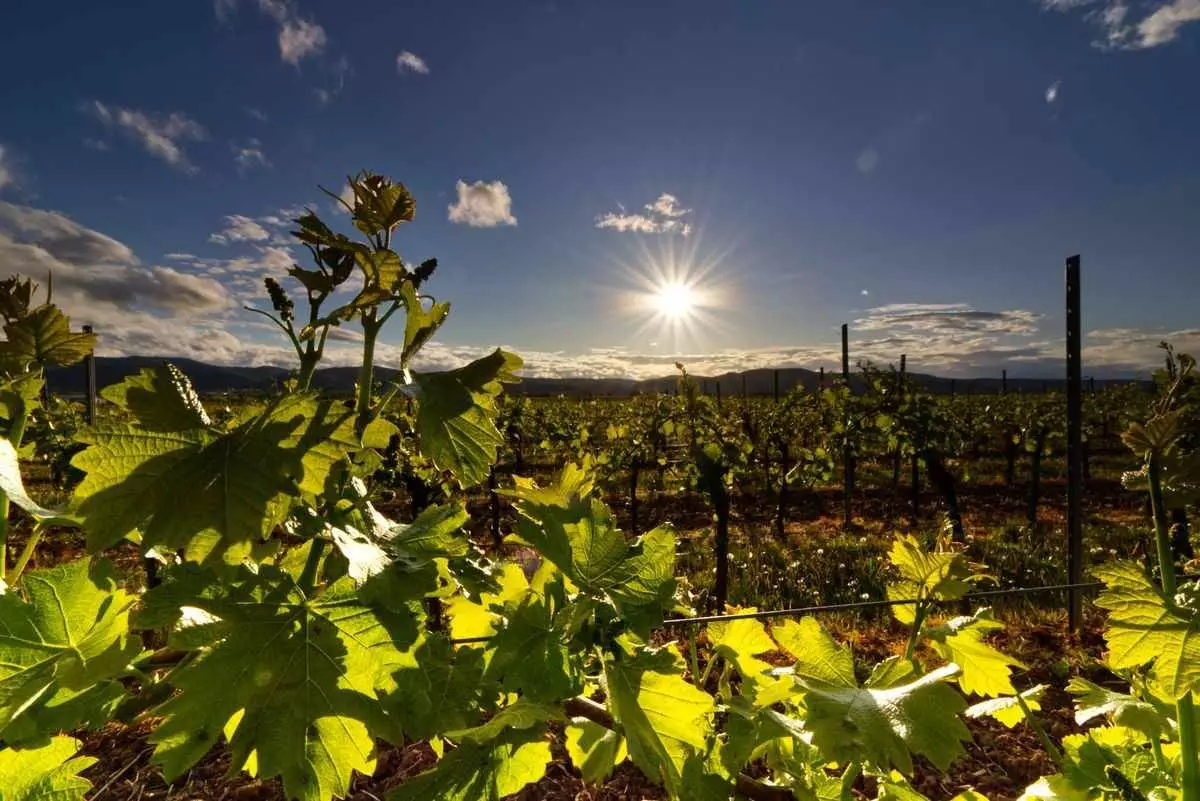
France did not invent wine, but it turned wine into art. Greek settlers from Phocaea planted the first vines in Provence some 2,600 years ago and the Romans spread viticulture across Gaul, but it was medieval monks — above all the Cistercians of Burgundy — who began studying how each plot of land produced a different wine. That obsession with soil, climate and slope orientation has a name the entire world has adopted without translation: terroir. With roughly 790,000 hectares of vineyard, some 363 appellations of origin (AOC/AOP) and production estimated at 35.9 million hectoliters in 2025 — the second highest in the world after Italy — France remains the global benchmark for wine. But the numbers do not tell the best part: the best part is to walk those regions with your feet on the ground, a glass in your hand and the landscape unfolding between rows of vines.
Burgundy: where every plot has its own name
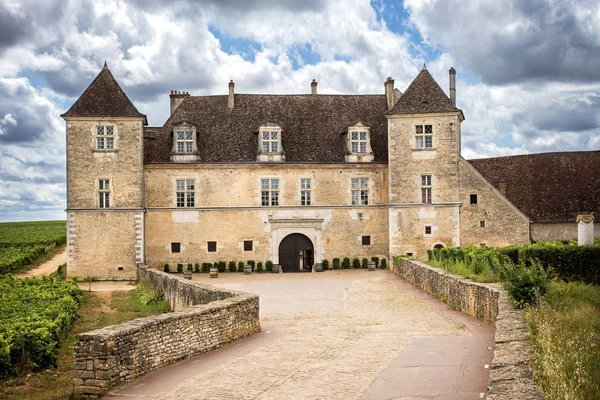
If there is one place on earth where the concept of terroir reaches its most radical expression, it is Burgundy. Its vineyards stretch some 250 kilometers from north to south, from Chablis to the Mâconnais, but the essence is concentrated in a narrow strip called the Côte d’Or — the Golden Slope — itself divided into the Côte de Nuits to the north and the Côte de Beaune to the south. Here, two grape varieties reign almost without competition: Pinot Noir for reds and Chardonnay for whites. The extraordinary thing is that neighboring plots, sometimes separated by nothing more than a dirt path, produce radically different wines. The Burgundians explain this through the combination of limestone soil, sun exposure and microclimate, and they have classified their vineyards into four tiers: regional, village, premier cru and grand cru, a system of 84 appellations representing more than 23% of all French AOCs. The Clos de Vougeot, a walled vineyard of 50.6 hectares created by Cistercian monks from Cîteaux Abbey between the twelfth and fourteenth centuries, is the symbol of this tradition: the monks were already separating cuvées from different parts of the plot to achieve a superior wine.
Beaune and the oldest auction in the world
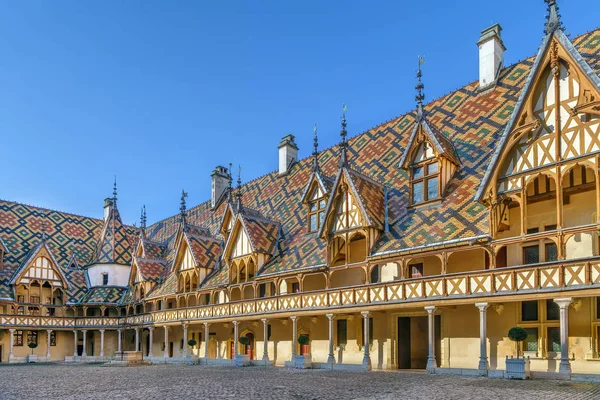
The town of Beaune is the unofficial capital of Burgundy wine, and its most famous monument is neither a church nor a castle but a hospital. The Hospices de Beaune — the Hôtel-Dieu — were founded in 1443 by Nicolas Rolin, chancellor of the Duchy of Burgundy, as a hospital for the poor. Its inner courtyard, with glazed tile roofs arranged in colorful geometric patterns that have become an icon of the region, is one of the most recognizable images of France. But what makes the Hospices unique is their 60-hectare vineyard, 85% of which is classified as premier cru and grand cru, whose production is auctioned every year on the third Sunday of November. Held since 1859, it is the oldest charity wine auction in the world, and its prices set the tone for the entire Burgundy harvest. The auction takes place within Les Trois Glorieuses, three days of celebration devoted to the food and wines of Burgundy that turn Beaune into one continuous feast.
Beaujolais: the Gamay grape and the new wine celebration
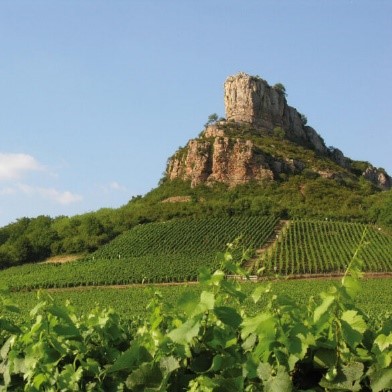
Just south of Burgundy, Beaujolais offers a fascinating contrast. While Burgundy reveres Pinot Noir, here the undisputed star is the Gamay grape, expelled from Burgundy’s vineyards by decree in the fourteenth century and which found its ideal home in the granitic soils of this region. Beaujolais is known worldwide for Beaujolais Nouveau, a young wine released at 00:01 on the third Thursday of November. The tradition dates back to the nineteenth century, when winemakers would toast the new vintage to celebrate the end of the harvest. In the 1970s and 1980s, producer Georges Dubœuf turned it into a global phenomenon with the famous slogan “Le Beaujolais Nouveau est arrivé!” and a race to deliver the first bottles to Paris and beyond. But Beaujolais is far more than Nouveau: it has ten crus — Moulin-à-Vent, Fleurie, Morgon, Brouilly, among others — that produce reds of great character, capable of aging for years. The Rock of Solutré, a spectacular limestone escarpment rising 493 meters above the Mâconnais vineyards, marks the visual boundary between Burgundy and Beaujolais and overlooks the Pouilly-Fuissé appellation, classified as premier cru since 2020.
Beyond Burgundy: a country of a thousand vineyards
Burgundy and Beaujolais form the wine heartland covered in our 14-day guide to France, but the map of French wine regions stretches far beyond. Champagne, northeast of Paris, is the homeland of the world’s most celebrated sparkling wine. The méthode champenoise — a second fermentation in the bottle — transforms Pinot Noir, Pinot Meunier and Chardonnay grapes into bubbles that no other region on earth may call champagne. Alsace, on the German border, produces aromatic whites from Riesling, Gewürztraminer and Pinot Gris that account for 90% of its output, set against a landscape of half-timbered villages and terraced vineyards lining the 170-kilometer Alsace Wine Route. The Loire Valley, the garden of France, offers astonishing diversity: Chenin Blanc in Vouvray, Sauvignon Blanc in Sancerre, Cabernet Franc in Chinon, all along the banks of France’s longest river and dotted with Renaissance châteaux. The Rhône Valley splits into two worlds: in the north, Syrah reigns on steep hillsides like Hermitage and Côte-Rôtie; in the south, the wines of Châteauneuf-du-Pape blend up to thirteen grape varieties under the Mediterranean sun. And Provence, the oldest wine region in France with 2,600 years of history, today devotes almost all of its production to rosé, a wine that has gone from summer indulgence to worldwide phenomenon.
Understanding terroir: more than a soil, a philosophy
The French appellation system, created in 1935 with the founding of the Institut National des Appellations d’Origine (INAO), is not just a label: it is a philosophy. An AOC — or AOP, as it has been called since the European harmonization of 2012 — regulates which grape varieties may be planted, how the vines are pruned, planting density, maximum yield per hectare and even the method of vinification. The aim is not to standardize but to protect the identity of each place. When a Burgundian says their wine tastes of its plot and not of the grape variety, they are not being poetic: they are describing the result of centuries of observation. The climats of Burgundy — those meticulously delineated vineyard plots — were declared a UNESCO World Heritage Site in 2015, recognizing that they represent a unique model of terroir-based viticulture. The traveler who visits French cellars does not merely taste wine: they take part in a millennia-old conversation between human beings and the land.
Tips for the wine-loving traveler
The grape harvest usually takes place between September and October, and it is the most vibrant time to visit wine regions: the vineyards turn gold, the cellars buzz with activity and many producers open their doors to visitors. Outside the season, spring brings green vineyards and fewer crowds. In Burgundy, the Route des Grands Crus covers 60 kilometers between Dijon and Santenay past some of the most prestigious plots in the world. In Beaujolais, the wine routes wind through Gamay-covered hills with stops at caves and family domaines where tastings are often free and conversation generous. A practical tip: during tastings, do not feel intimidated by technical vocabulary. French winemakers appreciate honest curiosity, and the best question is always the simplest: “Pourquoi ce vin a-t-il ce goût?” — why does this wine taste this way? The answer, invariably, begins by pointing at the ground beneath their feet.
If you want to tour the vineyards of Burgundy and Beaujolais with detailed itineraries, our 14-day France guide includes day-by-day routes with Google Maps, recommended wineries, restaurants with local food-and-wine pairings, visiting hours and practical tips to enjoy French wine without missing a thing.
Comments
Get the best travel tips
Subscribe to the Omyguide blog and never miss an article.
No spam. Unsubscribe anytime.